The Need For Substation Time Sync
Substations require time sync for many measurement applications. The most demanding is I-V sensing both sides of a transformer, requiring 4800 Hz samples to be timestamped ideally with 250ns local granularity (IEC Class A), but others are equally important, such as comparing synchrophasor measurements over transmission line distances, requiring traceability to UTC (IEC Classes B-F).
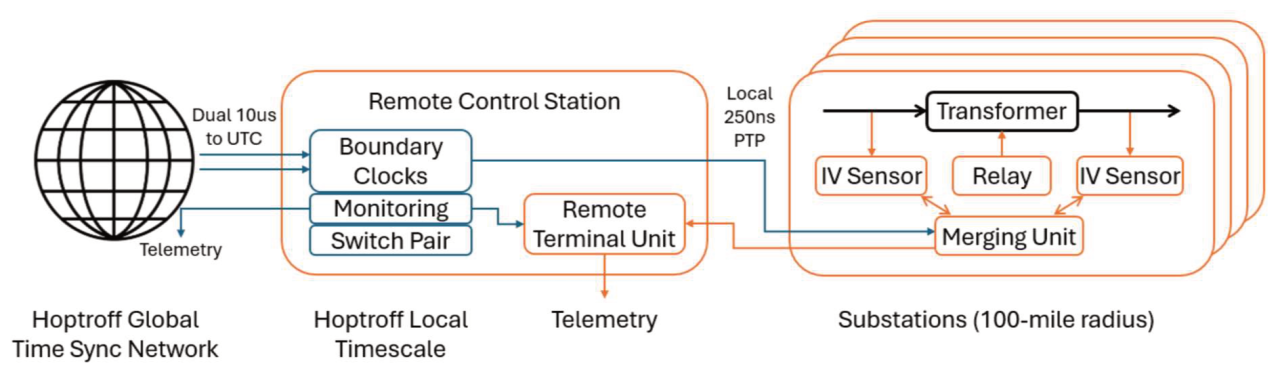
Substations within a 100-mile radius are managed by a single Remote Control Station. Local synchronization within the 100-mile radius should ideally be 250ns for Class A applications.
Control Stations within a power distribution network should be synchronized ideally to within 10μs of UTC for Classes B-F
Hoptroff Time Sync Solution
Hoptroff operates a global time synchronization network, operating resilient UTC timescales worldwide. It obtains time from multiple sources including terrestrial connections direct to national UTC labs to provide spoof-proof
service, and distributes it to customers over engineered IP networks to Critical Infrastructure facilities including Finance and Media.
As shown in the figure below, Hoptroff would provide boundary clocks at the Remote Control Station that connect to the network to obtain time and distribute it to the substations. A monitoring server reports back to Hoptroff that that Merging Units are correctly requesting time. All devices and connectivity are dual and diverse to ensure service resilience.

Time Sync Accuracy Requirements
The IEC 61850-5:2013 Standard quantifies time sync accuracy requirements as detailed in the table below.
| Class | Accuracy | Application |
| A | 1μs Local | Phasor and I-V measurements |
| B | 100μs UTC | Automated fault recording |
| C | 1ms UTC | Time tagging transient events |
| D | 10ms UTC | Power quality measurements |
| E | 100ms UTC | Slow event monitoring and logging |
| F | 1s UTC | Non time-critical monitoring |
Hoptroff Time Sync Benefits
Cost – Typically we provide cost savings of 50% compared to in-house timing installations.
Opex – not Capex, with an annual fee for time service, monitoring and support replacing an up-front cost.
GPS Resilience – The Hoptroff Time Sync service, with terrestrial connections to National Measurement Institutes including NIST in the United States, is unaffected by GPS denial and spoofing in the field, conforming to US Executive Order 13905.
Support – Hoptroff monitors the time service to Merging Units and provides timely advice if any devices are not requesting time correctly.
Hassle Free – time management with less hardware deployed in the field being subjected to the elements.