By Robyn Federman, Head of Global Commercial Marketing for Orolia
Most think of GPS as simply a way to get directions from their smartphone, or to tell a friend where they’re hanging out. Those of us who develop resilient positioning, navigation and timing solutions (PNT) for a living know that there’s a lot more to it.
GPS generates about $1.4 trillion for the private sector, according to the National Institute of Standards and Technology (NIST). February 2021 marked the one-year anniversary of the federal government’s Executive Order on Resilient PNT, which identified these six GPS-dependent infrastructure areas as critical to the national and economic security of the United States:
- Electrical power grid
- Communications infrastructure and mobile devices
- All modes of transportation
- Precision agriculture
- Weather forecasting
- Emergency response
For any of these critical areas, losing the GPS signal either due to intentional attack or accidental outage would wreak havoc, both in terms of lost services, lost revenue and potentially lost lives. The impact of lost services is easy to imagine: No traffic lights, no electricity, no trains or subways; digital phone networks that can’t relay calls; emergency rescue teams that can’t locate their victims. But what do you think the economic impact of a GPS outage might be?
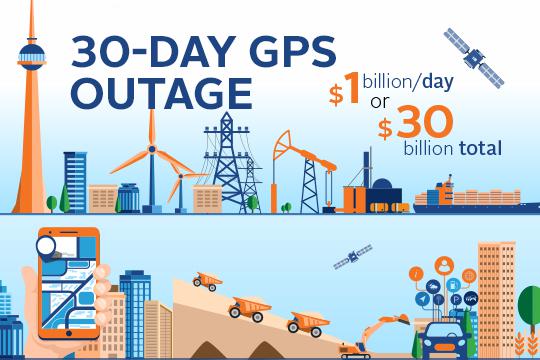
As it turns out, in 2018 NIST commissioned a research study to determine exactly that. Over a 30-day period, it’s about a whopping $30 billion. That’s enough to give you pause, if you haven’t thought about this issue already.
Obviously, some infrastructures would be more affected than others. For example, the impact to the financial industry would be near zero. Why? Because they already have robust and resilient backup systems in place to augment GPS in the event of a signal loss. Business as usual, then, for Wall Street.
But how about the six critical infrastructure areas outlined in the PNT Executive Order? As you might expect, it varies significantly by industry. The following infographic shows you the financial impact of a 30-day GPS outage, on an industry-by-industry basis.

So the next time you’re stuck in a tunnel underground and your smartphone won’t give you directions, remember this: It could be a lot worse. And count your blessings that companies like Orolia and other members of the Open PNT Industry Alliance, along with the Resilient Navigation and Timing Foundation, are fighting to ensure that a wide range of backup solutions for GPS signal loss are being developed, promulgated and thoroughly studied by the appropriate government agencies. To learn more, we suggest the following resources:
Resilient Navigation and Timing Foundation
Robyn Kahn Federman develops integrated multichannel marketing programs for Orolia’s commercial sector. Prior to joining Orolia, she was Director of Marketing and Communications for a direct and digital marketing agency. She holds an MS in journalism and advertising from the University of Kansas, an MS in sociology from the University of Chicago and is a certified content strategist.