Visibility Is an Urgent Challenge
Lack of visibility is behind the worst of IT headaches, leaving the network open to malicious intrusions, as well as compliance, availability, and performance problems. Today’s soaring traffic volumes are bringing greater complexity, proliferating apps and devices, and rising virtual traffic—in fact, “east-west” traffic between virtual machines now makes up half of all traffic on the network. Virtual traffic is the culprit that spawns unmonitored “blind spots,” a breeding ground for errors and attacks.
All these challenges make visibility critical to network security and management. Customers need a highly scalable visibility architecture—one that can eliminate blind spots and reduce complexity, while providing resilience and control. Visibility relies on monitoring tools, and new tool investment can be a real budget-buster. That’s why companies need to protect their investments in 1GbE and 10GbE monitoring tools, and why load balancing has become such a smart approach. Now, as networks move into the 100GbE environment, Ixia offers the NTO 7300, enabling total visibility into multiple 100GbE links and dominating its competition.
Dramatic Design Difference
The NTO 7300 delivers the ability to optimize 1GbE and 10GbE monitoring tools for the intensive 100GbE environment and offers decisive advantages over competitors. No other solution packs as many ports into a compact footprint for industry-leading density and cost-efficiency. The NTO 7300’s one-two punch of design ingenuity plus advanced technology makes it the clear choice in every comparison. If you take a typical 100GbE deployment that requires 8 100GbE ports, advanced filtering, and 10GbE ports for tool access, it becomes clear that other solutions cannot keep up with the density and performance Ixia provides.
The Numbers Speak for Themselves
Compare the Ixia NTO 7300 to its closest competitor, and you see a striking difference in capacity, scalability and performance. The NTO 7300 commands every category for customer needs by providing more performance in 71% less space!
 |
 |
| 7300: Port-Plentiful
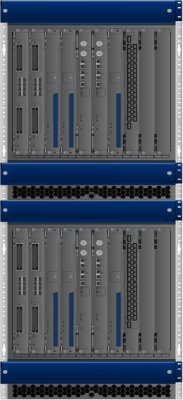
The Ixia NTO7300 configuration fits neatly and entirely in a single 8U chassis, with many unused ports. |
Competition: Port-Poor
This competitor requires 28U and has insufficient 40GbE ports. It’s significantly lower in density, with no ports on advanced processing blades and fabric modules placed awkwardly in front. |
| Per Chassis:24 40GbE ports (or 96x10GbE)
64 10GbE AFM ports 8 100GbE ports 640Gbps Deduplication |
Per Chassis (2 chassis required):2x40GbE ports
40x10GbE ports 4x100GbE ports 240Gbps Deduplication |
With its “pay as you grow” scalability; savings on rack space and power; a simple, rack-mountable chassis; superior advanced features such as header stripping and deduplication; and wire-speed performance in any configuration, the NTO 7300 is ideal for filling that critical visibility gap in the 100GbE environment.
| Ixia NTO7300 | Other | |
| Fabric Module location | Rear panel | Occupy front slots |
| 100GbE configuration | 2x100GbE + 4x40GbE or 16x10GbE | 2x100GbE + 8x10GbE |
| Advanced Processing capacity per slot | Up to 640Gbps (320Gbps ingress + 320Gbps egress) | Up to 80Gbps |
| Advanced Processing card configuration | 2xAFM16s + 4xQSFP + 640Gbps AFM, per slot | No tool or network ports, “the other’s” processor only |
| Slots per chassis | 6 | 8 |
| Chassis RU | 8 (with AC shelf) | 14 |
| Total Configuration | Ixia NTO7300 | Other | Advantage |
| 10GbE ports | 64 (up to 160) | 80 (up to 96) | Ixia (67% more max) |
| 40GbE ports | 96 | 8* | Ixia (1100% more max |
| 100GbE ports | 8 | 8 | |
| Deduplication bandwidth | 640Gbps | 480Gbps* | Ixia (33% more) |
| Total RU | 8 | 28 | Ixia (71% less) |
| *Doesn’t meet requirements | |||
Additional Resources:
Thanks to Ixia for the article.