5G is doing more than just speeding up our downloads—it’s completely changing how mobile networks are architected. Unlike the LTE era, which largely relied on frequency synchronization, 5G networks running on Time Division Duplex (TDD) spectrum operate on a much tighter leash.
In this landscape, “close enough” doesn’t cut it. To get maximum spectral efficiency and prevent radio interference, your network needs rigorous phase and time synchronization. At Telnet Networks, we know that timing is the invisible heartbeat of your RAN—if it skips a beat, the whole system feels it.
Why Timing is the Real MVP of 5G
The shift to TDD means that uplink and downlink transmissions happen on the same frequency, just separated by tiny slices of time. If your radios drift even slightly, those time slots start to overlap. The result? Signals collide (interference), calls drop, and your expensive spectrum goes to waste,.
Beyond basic connectivity, the “cool stuff” in 5G—like beamforming, massive MIMO, and cooperative multipoint (CoMP)—relies on multiple radios acting as a single coordinated unit. Without precise synchronization, these advanced features simply won’t work.
The Numbers: What 5G Actually Requires
To keep the network green, you need to hit some aggressive timing budgets:
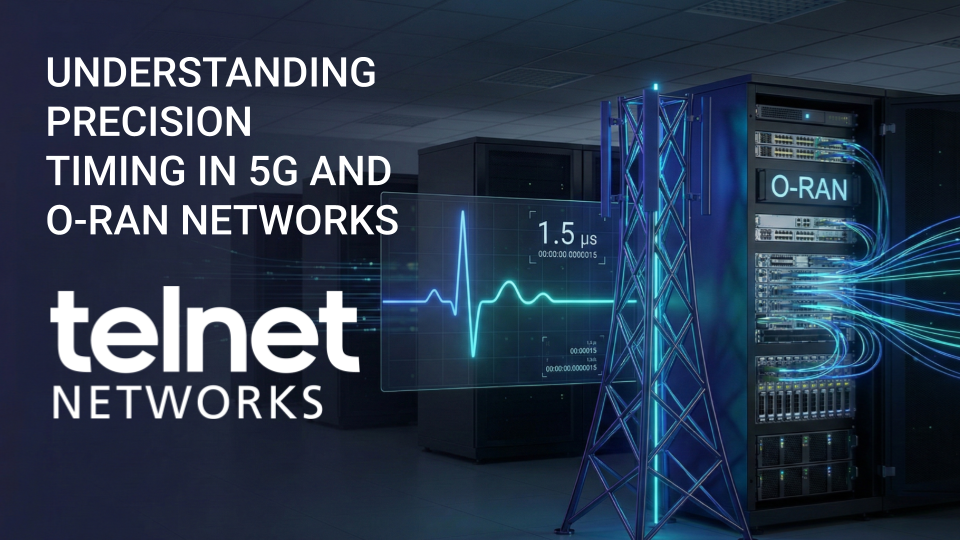
- The Golden Rule: For standard 5G TDD operations, the absolute time error across the network usually can’t exceed ±1.5 µs (microseconds),.
- Advanced Applications: Things get tighter for advanced radio coordination. CoMP (Coordinated Multipoint) often demands relative timing of <1 µs between radios to prevent interference.
- Positioning Services: If you are running location-based services (like asset tracking or emergency response), you might need accuracy as tight as 100 ns.
- O-RAN Fronthaul: In Open RAN setups, to ensure different vendors’ equipment plays nicely together, components often need Class A compliance (around 65ns relative error).
Meeting these targets requires hardware that can see problems before they happen. Here is how solutions from Safran and Timebeat fit into the picture.
Safran: Resilience for the Long Haul
When you need to distribute time over long distances—like across a mobile backbone—fiber links can introduce jitter and asymmetry. Safran solves this with their White Rabbit technology (High Accuracy profile), which uses IEEE 1588-2019 to deliver sub-nanosecond accuracy over fiber optics.
Safran focuses on resilience. Their gear is built to keep your network ticking even if GNSS (GPS) signals are jammed or spoofed.
Top Safran Appliances:
- SecureSync Grandmaster: This is a battle-tested GNSS time server. It prioritizes references and manages failovers automatically. If you lose your satellite signal, its internal oscillator holdover keeps your time drift under 1 µs for 24 hours.
- WR Z16 (White Rabbit Node): Designed for distribution, this node achieves deterministic sub-nanosecond performance. It features a Failover Clock Algorithm (FOCA) that instantly switches sources if a glitch is detected, ensuring your backbone never blinks.
Timebeat: Sync at the Edge
As we move toward O-RAN and Private 5G, timing needs to move closer to the user. Timebeat specializes in bringing precision directly into the server infrastructure and solving the “single point of failure” problem.
The Open Time Appliance: The Power of Three
Traditional timing setups rely on a single Grandmaster clock. If it fails or gets spoofed, you have a problem. Timebeat’s Open Time Appliance uses a Clock Quorum approach—uniting three devices into a self-verifying network.
- Quorum Consensus: The system cross-checks timing across three sources. If one clock drifts or provides bad data, the other two overrule it, ensuring the network always receives “proven” time.
- Compact Efficiency: You get this triple-redundancy (which usually requires massive rack space) in a form factor that fits three units into a single 1RU space.
- High Precision: Capable of <5ns accuracy, with multi-GNSS disciplining to verify signals across GPS, Galileo, and others.
The O-RAN Timecard
For server-based deployments, Timebeat offers the O-RAN Timecard (built on the Intel E810 / E835 NIC). This turns a standard commercial server into a precision sync hub.
- Plug-and-Play Precision: It delivers nanosecond-level sync and is Class A O-RAN compliant (≤50ns).
- Cost Effective: By integrating the Grandmaster function directly into the server (PCIe), you eliminate the need for expensive external timing boxes and save on cabling and power.
- Resilient: Includes an integrated GNSS receiver and high-stability oscillator for holdover, perfect for private networks or indoor deployments where signal visibility is tricky.
Ready to Synchronize Your Strategy?
Bad timing shouldn’t be the bottleneck in your 5G deployment. Whether you need a resilient backbone or a server-integrated edge solution, Telnet Networks has the expertise to design the right architecture for your rollout.
Contact Telnet Networks Today for a Consultation – Let’s ensure your network never skips a beat.