Introduction
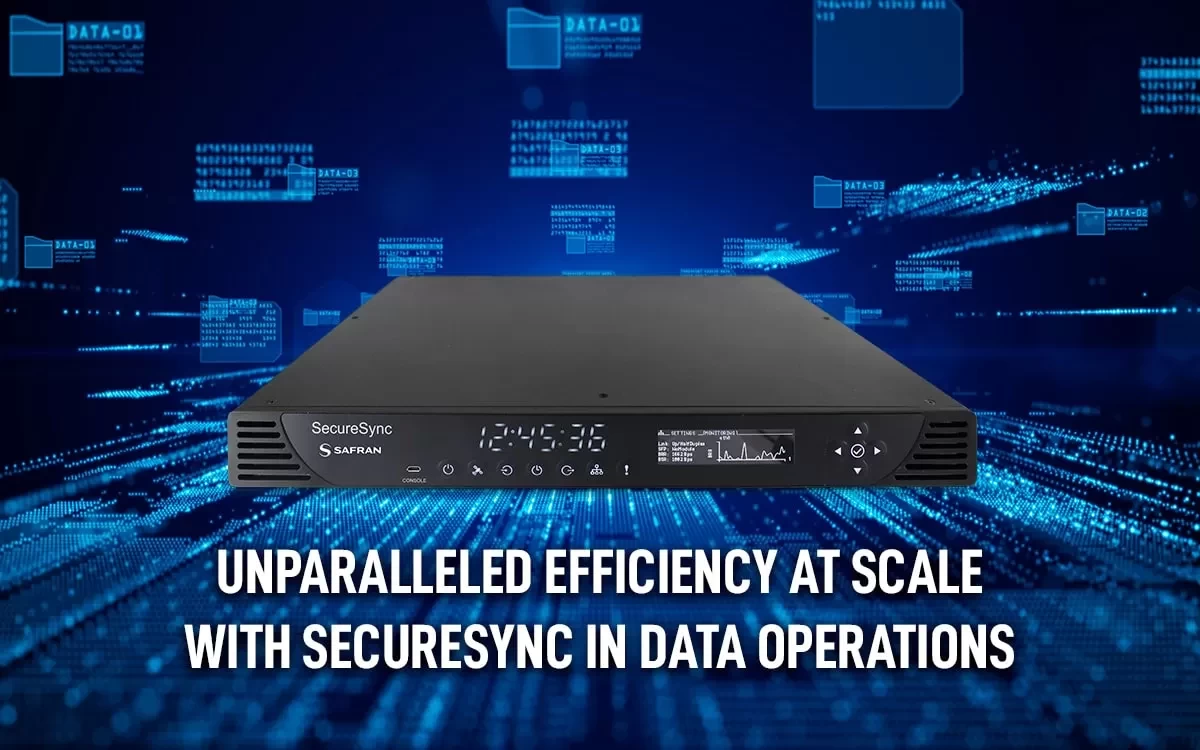
In the era of big data and distributed systems, achieving efficiency at scale is crucial for data operators. The Safran SecureSync emerges as a game-changing solution, providing unparalleled efficiency and reliability in time synchronization for data operations. We will explore the technical details behind the SecureSync and demonstrate how data operators can gain significant efficiencies at scale by leveraging its advanced features.
Exceptional Precision and Reliability
The SecureSync boasts exceptional precision and reliability, ensuring accurate time synchronization across distributed systems. Its innovative architecture combines precision timing components and advanced technologies, delivering ultra-low phase noise and frequency accuracy. With a holdover stability of <1 µs/day, the SecureSync guarantees uninterrupted synchronization, even in the event of temporary loss of reference signals.
High Scalability and Flexibility
Data operators often deal with expanding infrastructures and evolving requirements. The SecureSync is designed to address these scalability challenges. It supports a high number of simultaneous network clients, accommodating large-scale distributed systems effortlessly. Whether deployed in a small cluster or a global network, the SecureSync seamlessly integrates with existing infrastructure, providing precise time synchronization across all nodes.
Robust Timing Redundancy
The SecureSync ensures reliability in demanding operational environments through its timing redundancy capabilities. It incorporates dual-redundant power supplies and accepts multiple timing sources, minimizing the risk of single points of failure. Redundant timing sources and power supplies guarantee continuous synchronization and prevent disruptions that could impact data operations.
Advanced Network Time Protocol (NTP) and Precision Time Protocol (PTP) Support
SecureSync supports both NTP and PTP, enabling compatibility with a wide range of distributed systems. NTP provides accurate time synchronization for applications that require millisecond-level accuracy, while PTP offers sub-microsecond synchronization for applications with stringent timing requirements. The SecureSync’s ability to support both protocols ensures flexibility in integrating with various data operations, optimizing performance and efficiency.
Compliance and Traceability
Data operators often face stringent compliance requirements and the need for traceability in their operations. The SecureSync addresses these concerns by adhering to industry standards for time synchronization. It provides traceable and auditable event timestamps, facilitating compliance with regulatory frameworks and simplifying the audit process for data operations.
Comprehensive Management and Monitoring Capabilities
To efficiently manage and monitor distributed systems, the SecureSync offers advanced management and monitoring features. Its intuitive web-based interface allows for centralized control, configuration, and monitoring of multiple SecureSync units. The interface provides real-time status updates, performance metrics, and alerts, ensuring proactive management and facilitating rapid troubleshooting.
Conclusion
The SecureSync from Safran empowers data operators to achieve unparalleled efficiency at scale in their distributed systems. With exceptional precision, scalability, redundancy, protocol support, compliance adherence, and comprehensive management capabilities, the SecureSync proves to be a reliable and efficient solution for accurate time synchronization.
By leveraging the technical capabilities of the SecureSync, data operators can ensure seamless data operations, mitigate risks of inconsistencies, and optimize performance at scale. With its advanced features and robust design, the SecureSync emerges as a key enabler for data operators seeking efficiency, reliability, and compliance in their distributed data environments.