Skip to content

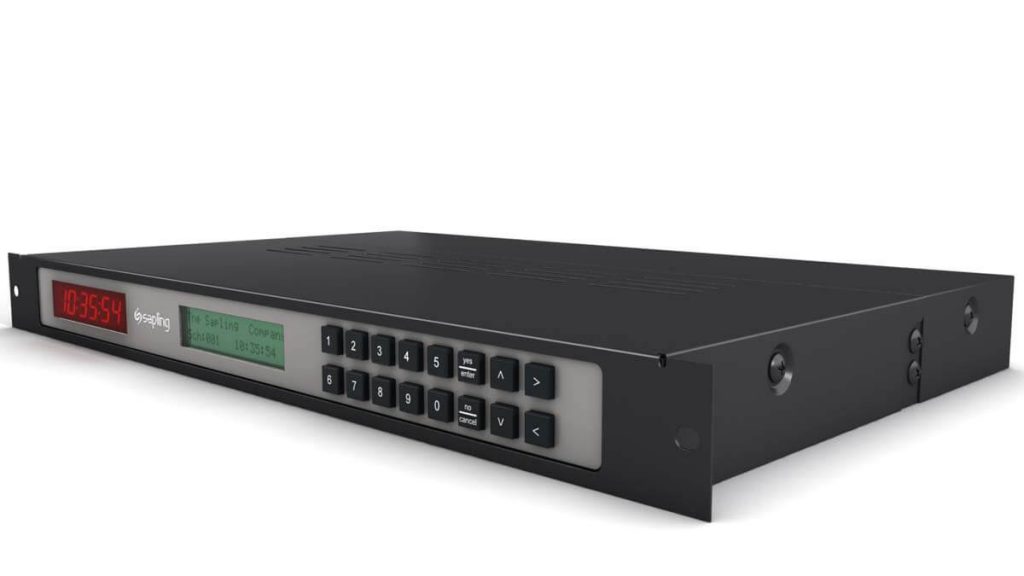
In continuing with our post explaining how Sapling’s master clocks can receive time, the second option a user has to receive time is through a GPS Receiver.

Receiving time from a GPS satellite is not only extremely accurate, it is also very secure. With the GPS Receiver, the facility does not have to go outside the facility’s established firewall and use a time source via the Internet.

A GPS receiver is built-in to the master clock and sends out the master clock’s exact location to satellites around the world. From the satellite, the master clock receives the accurate UTC (Coordinated Universal Time), then corrects to the local time based on the user’s location.

The GPS Receiver option can be used in conjunction with the NTP Server option, which you can learn about here. A user has the ability to choose which option will be the main time source and which will be the backup time source. By utilizing both options, a user will have redundancy within their system, ensuring accuracy. Receiving time via GPS is optional with a Sapling’s master clock.

Stay tuned next week for the third way Sapling’s master clocks can receive time! If you are interested in learning more about our master clocks in the meantime, visit our website for more info or check out our YouTube video explaining our master clocks more in depth.

Thanks to Sapling for the article.
Related Posts

What Is a Master Clock and Why Does It Matter?

What Is a Master Clock and Why Does It Matter?

Modern organizations rely on precise time synchronization to keep operations running smoothly and consistently. Critical systems across industries such as…
Understanding Keysight Threat Simulator & Adding Value in the First 24 Hours

Understanding Keysight Threat Simulator & Adding Value in the First 24 Hours

In 2026, assuming your network is secure because you bought the “best” tools is no longer a viable strategy. The…
Everything Network Engineers Need to Know about PTP

Everything Network Engineers Need to Know about PTP

Everything Network Engineers Need to Know about PTP Precision Time Protocol (PTP), standardized as IEEE 1588 in 2002, is a…
Beyond the "Perfect" Lab: Simulating Real-World Network Chaos Before Deployment

Beyond the "Perfect" Lab: Simulating Real-World Network Chaos Before Deployment

It is the classic IT paradox: your application performed flawlessly in the staging lab, but the moment it was deployed…
UNDERSTANDING ZERO TRUST -- WHY VISIBILITY IS THE BEDROCK OF “NEVER TRUST, ALWAYS VERIFY”

UNDERSTANDING ZERO TRUST -- WHY VISIBILITY IS THE BEDROCK OF “NEVER TRUST, ALWAYS VERIFY”

In our first post, we demystified the core philosophy of Zero Trust—shifting from the outdated “castle-and-moat” perimeter to a model…