

Precision timing is often associated with telecommunications, financial trading, or power grids, but its role in healthcare and emergency services is just as critical. In environments where seconds, milliseconds, or even microseconds can influence outcomes, accurate and resilient time synchronization helps ensure systems operate safely, efficiently, and reliably.
As healthcare networks become more digital and emergency response systems more interconnected, precision timing is moving from a behind-the-scenes technical requirement to a foundational capability.
Why Timing Matters in Healthcare and Emergency Services
Modern healthcare and emergency operations rely on networked systems, including medical devices, clinical platforms, imaging, communications, and dispatch centers. Precise timing ensures these systems correlate events, maintain data integrity, and support real-time decisions. Inaccurate time can cause data mismatches, delayed responses, compliance issues, and risks to patient and public safety.
Timing architectures must resist disruptions such as GNSS interference, network congestion, or equipment failures. Redundant sources, diverse inputs, and high-stability holdover oscillators maintain accuracy when primary references fail. Continuous monitoring and performance validation allow rapid detection of timing issues and timely correction, keeping healthcare and emergency systems synchronized and operational.
Key Healthcare Applications of Precision Time Solutions
Medical Device Synchronization
– Relies on precision timing to ensure patient monitors, infusion pumps, ventilators, and diagnostic devices operate on a shared time reference
– Enables accurate correlation of vital signs, alarms, and clinical interventions across multiple systems
– Provides the temporal accuracy needed for confident decision-making and reliable event analysis in critical care environments
Electronic Health Records and Clinical Systems
– Maintains correct sequencing of clinical events across hospital and healthcare networks
– Supports continuity of care, accurate documentation, and medico-legal requirements
– Enables reliable analytics for performance measurement, trend analysis, and outcome improvement
Medical Imaging and Diagnostics
– Coordinates data acquisition and processing for MRI, CT, and PET systems
– Improves image accuracy while reducing artifacts
– Supports alignment and secure sharing of diagnostic data across multi-site healthcare networks
Emergency Services Applications of Precision Time Solutions
Emergency Dispatch and Response Coordination
– Provides precise timestamps for call receipt, resource assignment, and response tracking
– Improves situational awareness, performance measurement, and compliance with service-level requirements
– Enables accurate event correlation across police, fire, and emergency medical services
Public Safety Communications
– Supports reliable operation of LTE and 5G-based public safety networks
– Enables accurate handovers, location services, and prioritized communications during major incidents
– Maintains service availability through resilient timing architectures when primary sources are disrupted
Incident Reconstruction and Accountability
– Creates accurate timelines for post-incident investigation, reporting, and training
– Allows confident reconstruction of events across systems and agencies
– Supports continuous improvement and accountability to regulators and the public
Precision Timing Options
Accurate and reliable timing is critical for healthcare and emergency services, where every second can impact patient care and operational efficiency. Organizations need solutions that provide continuous, traceable, and resilient time across a variety of devices and systems. Telnet Networks delivers accurate and reliable timing for healthcare and emergency services through a portfolio of precision timing platforms and expert solution development and design services designed to keep complex networks fully aligned and operational. Enabling client organizations to provide continuous, traceable, and resilient time across a variety of devices and systems.
Safran SecureSync 2400
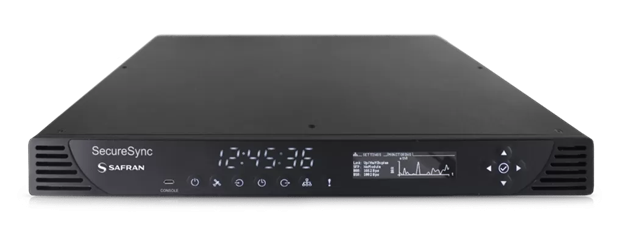
As the preferred masterclock/time server solution in NENA compliant environments, the Safran SecureSync 2400 is a Stratum-1 time server with multi-constellation GNSS support and hardware-assisted PTP and NTP services for precise time and frequency distribution. Its military-grade hardware supports redundant power supplies, multiple timing input and output formats, and high-stability oscillators for extended holdover. Advanced monitoring, alarm reporting, and security features enable continuous validation of timing performance, even during GNSS loss or interference.
Bodet Netsilon Master Clocks
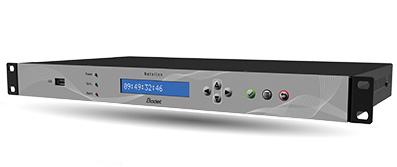
Bodet Netsilon provides a cost effective option for environments that require reliable time synchronization without many of the bells and whistles. Bodet Netsilon servers provide a number of output and oscillator options to fit the needs of a variety of deployment scenarios as NTP or PTP master clock. To ensure your healthcare or emergency service operations stay precisely synchronized and fully resilient, explore the right timing solution for your needs. Contact our sales team to discuss how Safran, Bodet, and our other precision timing solutions can keep your systems aligned and operating at their best.
