As we all know, technology has a life cycle of birth, early adoption, mainstream, and then obsoletion. Even the average consumer is very in touch with this lifecycle. However, within this overarching lifecycle there are “mini” lifecycles. One of these mini lifecycles that is particularly important to enterprises is the network design and equipment deployment lifecycle. This lifecycle is the basic roadmap of how equipment gets deployed within a company data network and key a topic of concern for IT personnel. While it’s its own lifecycle, it also aligns with the typical ITIL services of event management, incident management, IT operations management, and continual service improvement.
There are 5 primary stages to the network design and equipment deployment lifecycle: pre-deployment, installation and commissioning, assurance monitoring, troubleshooting, and decommissioning. I’ll disregard the decommissioning phase in this discussion as removing equipment is fairly straightforward. The other four phases are more interesting for the IT department.
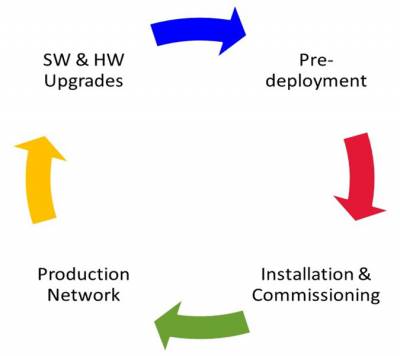
The adjacent diagram shows a map of the four fundamental components within this lifecycle. The pre-deployment phase is typically concerned with lab verification of the equipment and/or point solution. During this phase, IT spends time and effort to ensure that the equipment/solution they are receiving will actually resolve the intended pain point.
During the installing and commissioning phase, the new equipment is installed, turned on, configured, connected to the network and validated to ensure that the equipment is functioning correctly. This is typically the least costly phase to find set-up problems. If those initial set-up problems are not caught and eliminated here, it is much harder and more costly to isolate those problems in the troubleshooting phase.
The assurance monitoring stage is the ongoing maintenance and administration phase. Equipment is monitored on an as-needed or routine basis (depending upon component criticality) to make sure that it’s functioning correctly. Just because alarms have not been triggered doesn’t mean the equipment is functioning optimally. Changes may have occurred in other equipment or the network that are propagating into other equipment downstream and causing problems. The assurance monitoring stage is often linked with proactive trend analysis, service level agreement validation, and quality of service inspections.
Troubleshooting is obviously the reactionary portion of the lifecycle devoted to fixing equipment and network problems so that the network can return to an optimized, steady state condition. Most IT personnel are extremely familiar with this stage as they battle equipment failures, security threats and network outages due to equipment problems and network programming changes.
Ixia understands this lifecycle well and it’s one of the reasons that it acquired Breaking Point and Anue Systems during 2012. We have capabilities to help the IT department in all four of the aspects of the network design and equipment deployment lifecycle. These tools and services are focused to directly attack key metrics for IT:
- Decrease time-to-market for solutions to satisfy internal projects
- Decrease mean-time-to-repair metrics
- Decrease downtime metrics
- Decrease security breach risks
- Increase business competitiveness
The exact solution to achieve customer-desired results varies. Some simple examples include the following:
- Using the NTO monitoring switch to give your monitoring tools the right information to gain the network visibility you need
- Using the NTO simulator to test filtering and other changes before you deploy them on your network
- Deploying the Ixia Storm product to assess your network security and also to simulate threats so that you can observe how your network will respond to security threats
- Deploying various Ixia network testing tools (IxChariot, IxNetwork) to characterize the new equipment and network during the pre-deployment phase
Additional Resources:
Network Monitoring
Related Products
 |
 |
| Ixia Network Tap Ixia Net Optics network taps provide access for security and network management devices. |
Net Tool Optimizers Out-of-band traffic aggregation, filtering, dedup, load balancing |
Thanks to Ixia for the article.