Modern organizations rely on precise time synchronization to keep operations running smoothly and consistently. Critical systems across industries such as finance, emergency services, manufacturing, and healthcare depend on devices sharing an exact, unified time reference. This ensures events are recorded accurately, processes remain coordinated, and systems operate reliably.
In any time-sensitive environment, two fundamental challenges must be addressed:
1. Organizations must determine which clock will serve as the authoritative time reference for all connected systems. This source must be highly accurate and reliable so that every device in the network can trust the time it provides.
2. Determining how that time will be distributed across the network to other devices. Servers, control systems, monitoring tools, and facility clocks all need to receive the same time reference consistently and with minimal delay to maintain synchronization.
A master clock system solves both challenges by acting as a centralized source of precise time. It synchronizes with a trusted reference and distributes that time across an entire facility or enterprise, ensuring all connected systems operate on the same timeline.
What Is a Master Clock?
A master clock, sometimes referred to as a time server, is a highly precise timekeeping device that serves as the authoritative source of time for an entire network or facility. It receives its time from a trusted reference and ensures that all connected systems, often called secondary or slave clocks, are synchronized to the exact same time. This level of synchronization is critical in environments where even microsecond discrepancies can impact operations, including financial trading, telecommunications, industrial automation, and healthcare systems.
Master clocks typically obtain their reference time from highly reliable sources such as:
GPS or GNSS satellites – Globally recognized, highly accurate time signals
External NTP (Network Time Protocol) servers– Standardized network-based time
Local atomic clocks or high-stability oscillators- Independent precision timekeeping
Other trusted time standards- Based on organizational or regulatory requirements
Once a master clock acquires an accurate time reference, it distributes that time to all connected devices. This ensures that every system across the network operates in perfect synchrony, minimizing errors, maintaining compliance, and supporting seamless coordination across complex operations.
How Master Clocks Distribute Time
Modern master clock systems provide multiple methods for distributing precise time across an organization’s infrastructure, tailored to different environments and requirements.
Network-Based Time Distribution
Many systems synchronize time over IP networks using protocols such as:
NTP (Network Time Protocol) – commonly used to keep servers, workstations, and IT systems in sync
PTP (Precision Time Protocol) – provides sub-microsecond accuracy for industries like telecommunications, finance, and broadcasting
Wired Timing Signals – In specialized environments, master clocks can distribute time via copper or fiber connections using formats such as IRIG or other digital timing signals. This method is often used in aerospace, defense, and broadcast applications where extremely precise synchronization is required.
Wireless Clock Systems – Some master clock systems transmit time wirelessly to clocks throughout a facility, often using readily available unlicensed spectrum. This approach reduces installation complexity by eliminating extensive wiring while still maintaining accurate synchronization across all display clocks.
Why Accurate Time Synchronization Matters
Consistent time across devices and systems is essential wherever precision and order matter. Even small discrepancies can lead to data inconsistencies, failed transactions, security gaps, or compliance risks.
Organizations rely on synchronized time for a wide range of critical functions, including accurate event logging and security auditing, financial transactions and regulatory reporting, emergency response coordination, industrial automation, telecommunications, and healthcare systems. When all systems share a common time reference, teams can correlate events more effectively, troubleshoot issues faster, and maintain a clear, traceable record of operations.
Reliability and Redundancy
Modern master clock systems are built with resilience at their core. In environments where timing is critical, losing access to a primary reference source such as GPS cannot mean losing synchronization. To address this, these systems are designed with built-in redundancy that allows them to continue operating even when external signals are temporarily unavailable.
When a primary time source is lost, the system enters what is known as a holdover state, relying on a high-stability internal oscillator to maintain accurate time. These oscillators are engineered to minimize drift, ensuring that synchronization remains consistent across connected systems until the reference signal is restored. This level of reliability is essential for maintaining operational continuity and avoiding disruptions in time-sensitive applications.
The Role of Master Clocks in Modern Networks
While synchronized clocks were once primarily used for facility displays, today’s master clocks play a far more critical role. They act as the central timing authority across both operational technology and IT environments, supporting a wide range of interconnected systems.
Modern solutions integrate with network protocols, automation platforms, and monitoring tools to provide a unified and traceable time source across entire organizations. This enables accurate system logging, secure and verifiable timestamps, consistent synchronization across distributed networks, and support for advanced timing standards such as PTP.
As organizations continue to adopt distributed architectures and time-sensitive applications, the need for precise, reliable, and traceable time synchronization continues to grow. Master clock systems have become a foundational component of modern digital infrastructure.
Leading Master Clock Manufacturers
When evaluating master clock solutions, it’s important to consider the strengths and focus areas of different manufacturers. While all aim to deliver accurate and reliable time synchronization, each brings a unique approach based on target industries, deployment environments, and feature sets.
Safran
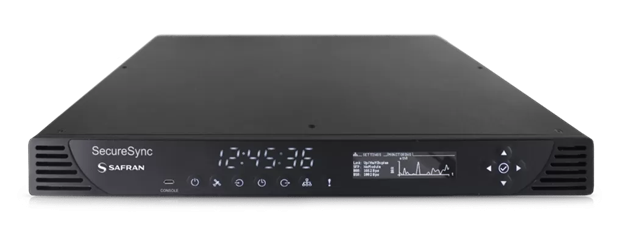
Safran is widely recognized for its high-precision timing solutions designed for mission-critical and regulated environments. Its master clocks and time servers deliver extremely accurate synchronization, often supporting advanced standards like Precision Time Protocol (PTP), multi-constellation GNSS inputs, and enhanced security features. These systems are commonly used in sectors such as telecommunications, finance, aerospace, and defense, where timing accuracy and resilience are essential.
Sapling
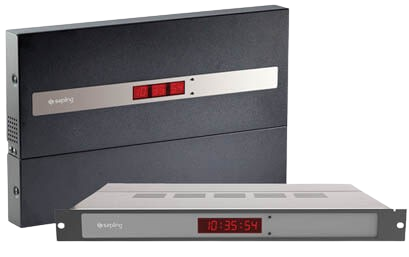
Sapling specializes in master clocks for time display units and systems including healthcare, education, and corporate facilities. Their master clocks serve as the central time source, delivering precise, reliable synchronization across both wired and wireless networks. Known for easy deployment and flexible configuration, Sapling’s solutions integrate seamlessly with existing infrastructure, while their traditional clock systems complement modern networked setups—making them ideal for organizations seeking accurate, resilient timekeeping with straightforward hardware management.
Bodet
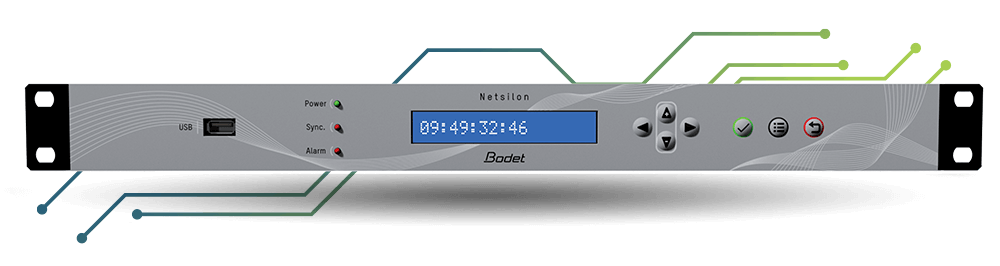
Bodet’s cost effective solutions provide a wide range of time synchronization solutions that bridge industrial performance with user-friendly design. Their master clocks support both NTP and PTP distribution, making them suitable for environments that require precise timing across IT and operational systems. Bodet is particularly strong in sectors like transportation, manufacturing, and public infrastructure, where cost, reliability, modularity, and scalability are key considerations.
Choosing the right master clock solution depends on your environment’s specific needs, including accuracy requirements, network complexity, regulatory considerations, and scalability. Whether synchronizing display clocks across a campus or ensuring precise timestamps across enterprise systems, the right master clock architecture provides the reliable, centralized timing needed to support both current operations and future growth. Contact our sales team to discuss the best synchronized time solution for your organization.