

Everything Network Engineers Need to Know about PTP
Precision Time Protocol (PTP), standardized as IEEE 1588 in 2002, is a network-based protocol that provides highly accurate time across packet-based networks. Designed to overcome the limitations of older protocols like NTP, PTP enables devices to synchronize to a master clock with sub-microsecond precision, ensuring precise event coordination and timestamps. Developed for industries such as telecommunications, finance, power, and broadcasting, PTP has evolved to support advanced applications like 5G, O-RAN, high-performance data centers, and industrial automation, making it essential wherever highly accurate, scalable network-wide timing is critical.
To achieve this level of accuracy across large and complex networks, PTP relies on a structured hierarchy of timing devices. Rather than every device communicating directly with a single time source, PTP distributes time through specialized components that maintain synchronization as it moves through the network. Two of the most important elements in this architecture are grandmaster clocks, which provide the authoritative time reference, and boundary clocks, which help distribute that time while preserving accuracy.
Grandmasters and Boundary Clocks
Grandmaster Clocks
A grandmaster clock is the main source of accurate time in a network, acting as the reference that all other devices, or “slaves,” follow. It provides precise timestamps that devices use to keep their internal clocks in sync. Grandmaster clocks get their time from highly accurate sources like GPS or atomic clocks. By keeping a stable and precise reference, grandmaster clocks make sure all devices in the network stay synchronized, allowing systems to operate reliably and in coordination.
Boundary Clocks
A boundary clock is a network device used in a PTP environment to help distribute accurate time across a network. It synchronizes to an upstream time source, typically a PTP grandmaster clock that may be disciplined by GPS, GNSS, or an atomic reference. The boundary clock receives this precise time on one port, aligns its internal clock, and then redistributes accurate timestamps to devices connected on its other network ports. By correcting for delay and jitter at each interface, it helps keep downstream devices closely synchronized.
Within a PTP timing structure, devices are organized in a hierarchy that protects time accuracy as it moves through the network. The grandmaster sits at the top as the primary time source, while boundary clocks form intermediate layers that receive time, regenerate it, and pass it to additional switches, routers, or end devices. This structure prevents timing errors from accumulating across multiple network hops and helps maintain precise synchronization in large environments such as telecommunications networks, data centers, and industrial systems.
Grandmaster vs Boundary Clock
In a PTP network, the grandmaster clock provides the primary source of accurate time, typically from GPS or atomic clocks, setting the reference for all devices. Boundary clocks distribute this time to multiple devices, reducing network delay errors and maintaining synchronization across large or complex networks.
| Feature | Grandmaster Clock | Boundary Clock |
| Primary Role | Main source of accurate time | Distributes time from a grandmaster to other devices |
| Connection | Usually connected to GPS, atomic clock, or other precise source | Connects to upstream time source (grandmaster) and downstream devices (time consumers) |
| Function | Provides authoritative time to the network | Acts as both receiver and sender of time |
| Network Ports | Typically single port | Multiple ports for distribution |
| Purpose | Sets the standard for network time | Maintains synchronization and reduces timing errors |
| Common Use | Provides network-wide reference | Ensures precise timing distribution in large or complex networks |
Why Does PTP Matter?
As networks support high-speed trading, 5G, smart grids, and real-time industrial systems, precise, traceable time has become critical. Traditional methods like Network Time Protocol were not designed for microsecond or nanosecond accuracy, and issues like latency variation, jitter, and asymmetrical paths can introduce timing errors. Precision Time Protocol addresses these challenges by compensating for packet delays, providing much greater accuracy across complex Ethernet networks.
PTP allows systems to operate as tightly coordinated units rather than loosely synchronized devices. In telecommunications, finance, broadcasting, and power utilities, even small timing errors can cause data loss, compliance issues, or instability. By delivering deterministic, high-precision synchronization over standard IP networks, PTP solves problems legacy methods cannot, ensuring the performance, reliability, and scalability modern infrastructure requires.
Key Applications of PTP
Telecommunications (4G LTE and 5G)
PTP ensures base stations and core network elements remain precisely synchronized. This timing accuracy is critical for handoffs, spectrum efficiency, and carrier aggregation, directly impacting network reliability and performance.
Financial Services and Trading
PTP provides exact timestamps for every transaction. Accurate timing is essential for regulatory compliance, auditing, and fair execution in high-speed trading environments.
Broadcast and Media Production
PTP synchronizes audio and video streams across all devices and networks. It eliminates drift, ensures lip-sync accuracy, and maintains reliable live and remote broadcasts.
Power and Energy Utilities
PTP aligns clocks across substations and phasor measurement units (PMUs). Precise timing supports accurate grid monitoring, faster fault detection, and stable power delivery.
Industrial Automation and Smart Manufacturing
PTP coordinates robotics, motion control, and sensors. Deterministic timing allows precise operations, improves product quality, and ensures safety in automated systems.
Healthcare and Hospitals
Hospitals rely on PTP to synchronize clinical systems, medical devices, and networks. It ensures accurate timestamps for health records, imaging, labs, and monitoring equipment, supporting patient safety and regulatory compliance.
Beyond PTP – White Rabbit Protocol
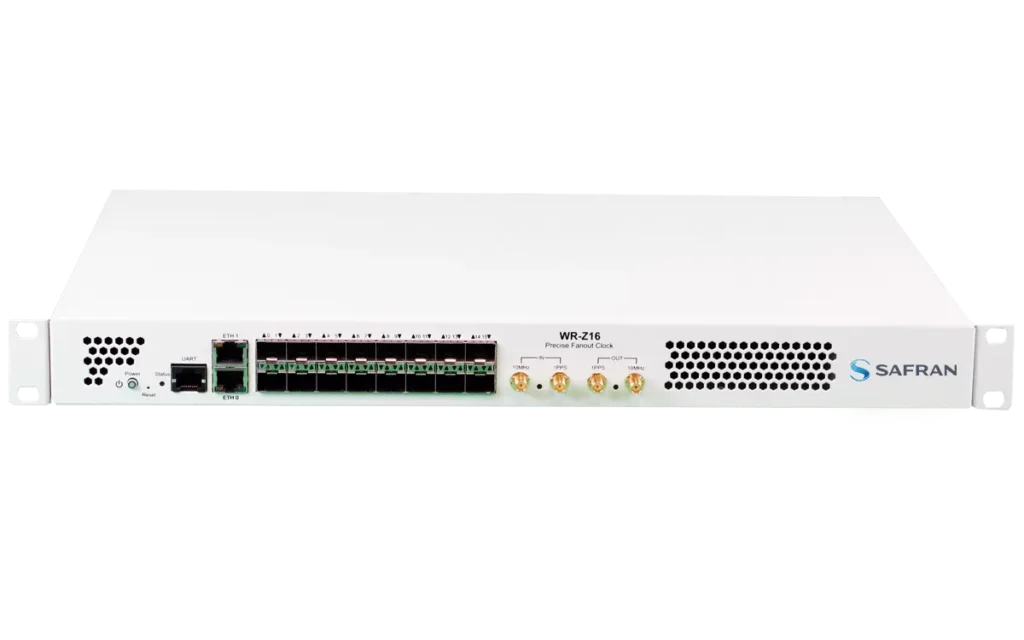
For applications requiring synchronization beyond what standard PTP can achieve, the White Rabbit Project extends its capabilities. Combining PTP with Synchronous Ethernet and precise phase measurement, White Rabbit achieves sub-nanosecond accuracy, making it ideal for scientific research, particle accelerators, telescope arrays, and other ultra time-sensitive systems. It delivers deterministic, ultra-precise timing that standard PTP cannot provide, enabling new possibilities for distributed systems that demand extreme coordination.
| Feature | PTP (Precision Time Protocol) | White Rabbit Protocol |
| Typical Accuracy | Microseconds | Sub-nanosecond |
| Time Distribution | Standard Ethernet | Synchronous Ethernet with phase measurement |
| Use Cases | Telecom networks, financial trading, broadcasting, industrial automation | Particle accelerators, telescope arrays, high-energy physics experiments, quantum networking and computing |
| Network Requirements | Standard Ethernet | Ethernet with precise timing support |
| Determinism | High | Ultra-high |
| Scalability | Enterprise and industrial networks | Specialized high-precision networks |
PTP Risks and Limitations
While Precision Time Protocol delivers high-precision synchronization, real-world networks can introduce challenges that limit its accuracy. Variable network delays, asymmetrical paths, and jitter can cause timing errors, especially in complex or heavily loaded networks. Hardware limitations, such as network switches or routers that do not fully support PTP, can further degrade performance. Additionally, maintaining PTP across wide-area networks (WANs) or mixed-vendor environments can be difficult due to compatibility and interoperability issues.
To address these challenges, several solutions are being implemented. Boundary and transparent clocks help compensate for network-induced delays, while hardware-assisted timestamping improves accuracy at the device level. Standards and profiles are evolving to improve interoperability across devices and vendors, making it easier to achieve consistent precision even in complex real-world deployments.
PTP Appliance Vendors
Across North America, several vendors provide high-quality PTP timing appliances such as grandmaster clocks, boundary clocks, and full time distribution systems. These solutions form the backbone of precision synchronization in telecom, finance, industrial, and critical infrastructure networks.
Key players include Microchip Technology Inc., which offers modular grandmaster systems designed for 5G and enterprise timing; Meinberg, known for its comprehensive line of GNSS-synchronized PTP appliances; and EndRun Technologies, which provides highly accurate grandmaster clocks capable of nanosecond-level performance. Alongside these established global vendors, specialized providers support diverse deployment needs with solutions tailored for mission-critical and complex networks.
Safran offers SecureSync based grandmaster clocks and time servers with microsecond‑level PTP precision and resilient GNSS disciplining. Their appliances support multi‑protocol outputs and White Rabbit extensions, making them suitable for regulated, mission‑critical environments where reliability and security are key.
Bodet delivers modular PTP/NTP grandmasters and boundary clock systems designed for enterprise, healthcare, transportation, and industrial applications. Bodet units provide cost efficient functionality and capabilities that ensure accurate distribution across complex networks.
TimeBeat focuses on scalable, resilient timing appliances that support high‑precision PTP distribution, robust GNSS disciplining, and enhanced architecture options for redundancy and long‑term stability. Their products are geared toward modern network timing needs where precision and uptime are critical.
| Vendor | Key Solutions | Typical Use Cases |
| Safran | SecureSync-based grandmaster clocks and time servers | Regulated and mission-critical environments requiring high reliability and security |
| Bodet Time | Netsilon 9 and 11 Modular PTP/NTP grandmasters and boundary clock systems | Enterprise, healthcare, transportation, and industrial networks |
| TimeBeat | Standalone PTP timing appliances and PCIe server cards | Modern networks where precision timing and uptime are critical |
Together, these vendors provide a range of timing sources from rugged edge devices to carrier‑grade grandmasters, giving network architects options that match their performance, scalability, and deployment requirements.
If Precision Time Protocol is something you are considering for your network, now is a great time to start the conversation. Whether you are planning a new deployment, upgrading your timing infrastructure, or simply exploring how PTP could improve accuracy and performance, our team is here to help. Contact our sales team to discuss your requirements and find the right solution for your environment.
