
Most 5G timing challenges trace back to one rule. Canada’s mid-band 5G, in the 3500 MHz and 3800 MHz bands, uses time division duplex (TDD): neighbouring cells share a frequency and take turns, all transmitting together and then all listening together. 3GPP puts a number on how closely they must agree. Cells on the same frequency with overlapping coverage must start their frames within 3 microseconds of each other, which ITU-T interprets as ±1.5 µs against a common reference such as UTC.
The rule doesn’t stop at your own network. ISED’s technical rules for these bands, SRSP-520, require licensees running unsynchronized TDD in adjacent blocks of the same area to coordinate with each other when their emissions cross set thresholds. Synchronized operation, with frames starting together and the same uplink and downlink periods, is one of the coordination techniques it names. In practice, time is part of how Canadian operators coexist.
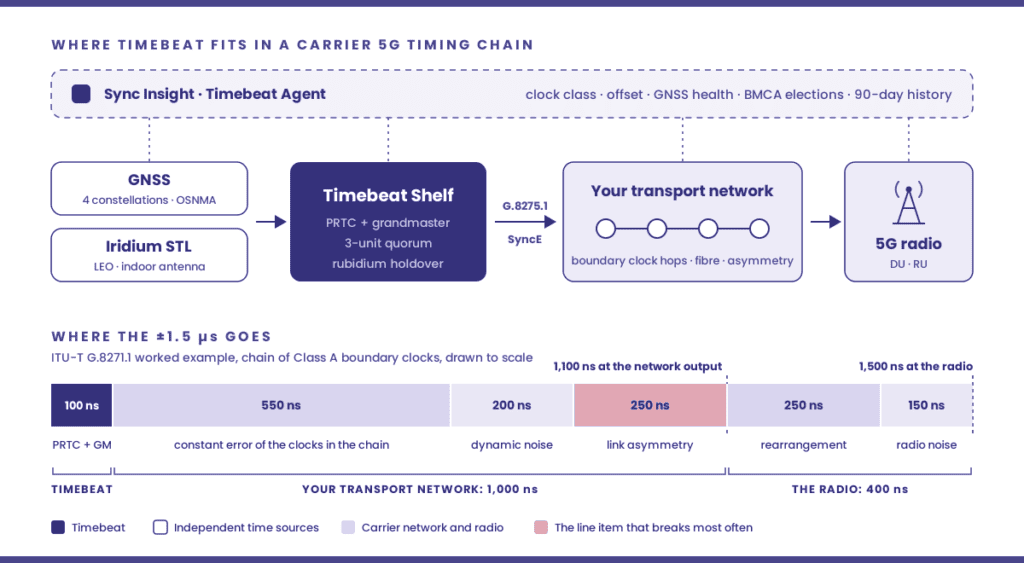
That ±1.5 µs is often quoted as if it belonged to the timing equipment. It doesn’t. In ITU-T’s own worked example, the grandmaster gets 100 nanoseconds of it, the radio keeps 400 ns for itself, and the transport network in between gets everything else.
So here is the limitation up front: no grandmaster, Timebeat’s included, can buy back budget that the transport network has already spent. What a grandmaster platform can do is make sure the source never becomes the problem, hold the line when GNSS disappears, and show you where the rest of the budget is going. Those are the challenges this post covers, and they are where Timebeat, our precision timing partner, has focused its engineering. If you’d like the fundamentals first, our earlier primer on precision timing in 5G and O-RAN networks covers them. This post is written for the people who design and run timing in national carrier networks.
Which standard says what
A lot of 5G timing conversations go sideways because the standards get blended together. A datasheet line such as “G.8275.1 compliant” is often read as a statement about accuracy. It isn’t. G.8275.1 is the PTP telecom profile: the rules for how timing messages are carried. The accuracy limits live in other documents.
| Document | What it defines | The number that matters |
|---|---|---|
| 3GPP TS 38.133 | Cell phase synchronization for TDD | 3 µs between overlapping cells on the same frequency |
| 3GPP TS 38.104 | Time alignment error between a base station’s transmitters | 65 ns for MIMO; 260 ns for intra-band contiguous carrier aggregation (FR1) |
| ITU-T G.8271 | Time and phase accuracy classes | Class 4: ±1.5 µs, which covers NR TDD |
| ITU-T G.8271.1 | Network limits with full timing support | 1.1 µs at the network’s output to the radio; 1.5 µs once the radio’s own error is added |
| ITU-T G.8272 | Primary reference time clock (PRTC) | PRTC-A within 100 ns of UTC; PRTC-B within 40 ns |
| ITU-T G.8273.2 | Boundary and slave clock performance | Maximum time error per clock of 100 ns (Class A), 70 ns (Class B) or 30 ns (Class C) |
| ITU-T G.8275.1 | The PTP telecom profile | Layer 2 Ethernet multicast, with a PTP-aware clock at every hop |
Two of those rows are where the hard engineering happens: the network limit, and the clocks that consume it.
Challenge 1: The transport network spends most of the budget
G.8271.1 includes a worked example of how the 1.5 µs is divided along a chain of Class A boundary clocks:
- 100 ns for the PRTC and grandmaster
- 550 ns for the constant time error of the clocks in the chain
- 200 ns for the chain’s dynamic noise
- 250 ns for link asymmetry
That reaches 1,100 ns at the network’s output. The radio then takes 250 ns to absorb reference rearrangements and 150 ns for its own noise, for 1,500 ns in total.
Two things fall out of that arithmetic.
First, asymmetry is the line item that breaks most often. PTP assumes the path to the grandmaster and the path back take the same time. When they don’t, half the difference becomes time error that PTP cannot detect on its own. Two microseconds of uncompensated asymmetry, from unequal fibre lengths in a pair, a transponder, or a protection switch that sends one direction of a link down a different path, is a full microsecond of error. Most of the network’s allowance, gone in one place.
Second, the tighter radio features shrink everything. Intra-band contiguous carrier aggregation needs the radios involved within 260 ns of each other. Once the radios take their share, G.8271.1 leaves the network roughly 100 to 190 ns, enough for about four to seven Class C boundary clocks between the common clock and the radios. That is one reason carriers move grandmasters closer to the edge, and it comes back in the next challenge.
Fixing this is transport design: full on-path support for G.8275.1, Class C boundary clocks where the budget is tight, enhanced SyncE underneath PTP, and asymmetry measured and compensated link by link. Measuring what a transport network actually does to PTP is a test discipline of its own; we covered fronthaul validation in our Open RAN post with Aukua. Timebeat’s contribution here is narrower, and we’d rather say so: a clean source at the top of the chain, and the visibility to find the link that is eating the budget, which we come to in challenge 4.
Challenge 2: GNSS is a single point of failure, and it’s noisy
Nearly every 5G timing chain begins at a GNSS antenna. That makes GNSS the one input whose failure takes everything downstream with it.
Canada has data on how often that input is disturbed. Researchers at York University and the Canadian Positioning, Navigation and Timing Office ran interference detectors in Vancouver, Montréal and Ottawa for about a year. They found that “GNSS receivers are subjected to a few minutes of interference everyday,” and that “approximately 14% of these events have the potential to cause receivers to lose lock” (Inside GNSS, January 2024). Many of the events carried the signature of personal privacy devices: cheap jammers that are illegal in Canada and in use anyway.
Jamming is the visible failure. The receiver loses lock, raises an alarm, and the grandmaster goes into holdover. Spoofing is worse because nothing alarms. A receiver fed a convincing counterfeit signal locks to it and hands the wrong time downstream as if it were right, and every radio follows. There is no national fallback to lean on either: Canada and the US switched off Loran-C in 2010, and no eLoran service replaced it.
Architecture decides how exposed you are. A centralized design has a few antennas at well-chosen sites that are easy to protect. A distributed design, the one tight carrier aggregation pushes you toward, puts receivers on rooftops across the city, in exactly the environment that study measured.
Timebeat’s answer is layered, and each layer covers a different failure:
- Two bands, four constellations. The Open Time Appliance’s u-blox LEA-F9T receiver tracks GPS, Galileo and BeiDou on two frequency bands (L1 with L2 or L5). Dual-band reception corrects ionospheric error, and a jammer that only covers L1 leaves the second band usable.
- Authentication. Galileo’s Open Service Navigation Message Authentication (OSNMA), declared operational by the EU Agency for the Space Programme in July 2025, cryptographically signs the navigation message so a receiver can reject data that didn’t come from Galileo. Timebeat implements it twice: in the receiver firmware, and at platform level through a separate authentication feed it calls Trust Bridge.
- An independent satellite layer. Timebeat adds Iridium Satellite Time and Location (STL) beneath GNSS. STL is broadcast from Iridium’s low Earth orbit constellation, which Iridium says delivers signals 1,000 times more powerful than GNSS. It works indoors with a small antenna, covers the globe (the far North included), and according to Timebeat delivers time to within 100 ns of UTC on its own. Timebeat cross-validates STL against GNSS and the internal oscillator every second, so a jammed, spoofed or lost GNSS source shows up as a disagreement instead of passing silently.
- Quorum. Timebeat’s Shelf puts three independent grandmasters in one rack unit, each with its own oscillator, multi-band receiver, antenna, power feed and PTP output. Software on each unit weighs its own GNSS against PTP from the other two, and the three run active-active with what Timebeat describes as millisecond failover. A quorum, in Timebeat’s words, “tolerates compromise of fewer than half of the participating references.” One bad receiver gets outvoted rather than obeyed.
Each layer has limits, which is why they’re stacked. OSNMA proves Galileo data is genuine, but it doesn’t stop jamming, and on its own it can’t rule out a genuine signal recorded and replayed with a delay. That’s where an independent source earns its place, and STL’s accuracy makes it more than a cross-check: at under 100 ns to UTC, it stays within the 100 ns that ITU-T’s worked example allows for the source, so STL can carry the timing chain while GNSS is down. At sites with heavy interference, an anti-jam antenna is still a separate decision.
Challenge 3: Holdover is a budget, not a feature
When every external reference is gone, the oscillator inside the grandmaster is the only thing keeping time, and its drift spends the budget. Datasheets usually quote holdover against 1 or 1.5 µs over 24 hours. That’s the wrong yardstick for a carrier, because the network has already claimed most of the 1.5 µs. G.8271.1’s worked example sets aside 400 ns for riding out a short GNSS outage.
The Open Time Appliance comes with a choice of three oscillators, and Timebeat publishes a 24-hour holdover figure for each:
| Oscillator | 24-hour holdover (Timebeat figure) |
|---|---|
| Quartz DOCXO | ±1.5 µs |
| Rubidium Black | under 500 ns |
| Rubidium Black+ | under 120 ns |
Read against a few hundred nanoseconds rather than 1.5 µs, the choice stops being academic. A quartz grandmaster is a sound choice where outages are short and repairs are quick. Where a failed antenna means a truck roll on a winter road, or a flight, rubidium is what keeps the radios inside budget until someone arrives. Treat every vendor’s holdover figure, these included, as a typical value under stable conditions, and ask how long the unit was locked beforehand and at what temperature it was tested. (Our guide to TCXO, OCXO and rubidium oscillators explains why those conditions matter.)
Holdover is also a property of the whole chain, not just the box at the top. ITU-T’s own examples make the point. With ordinary SyncE underneath PTP, G.8271.1 shows a day-long GNSS outage pushing time error at the radio to about 3.5 µs, more than twice the limit. With enhanced SyncE traceable to an enhanced primary reference clock, and Class C boundary clocks throughout, a three-day outage stays inside 1.5 µs. Both are informative examples rather than guarantees, but the direction is clear. The Open Time Appliance supports SyncE as both client and server, so it can take frequency from the network as well as give it. And where STL is fitted, the oscillator doesn’t have to run unaided at all: Timebeat says timing “holds without interruption” when GNSS is jammed, spoofed or lost, with STL keeping the source within 100 ns of UTC.
Challenge 4: Timing fails quietly
A 5G timing fault rarely announces itself as a timing fault. It shows up as interference between neighbouring cells, failed handovers, carrier aggregation dropping users, or throughput sagging in the busiest parts of the city. Each of those has other plausible causes, so a timing problem can spend days being investigated as something else. Timebeat’s co-founder and CTO, Lasse Johnsen, puts it bluntly: “If your NOC discovers a fronthaul timing problem because a customer complains about dropped calls, you have already lost.”
At minimum, a NOC needs to see:
- Clock class changes at every grandmaster and boundary clock. That is how a clock tells the network it has lost its reference.
- Measured offset at every slave clock, not only the grandmaster’s report that it is locked.
- Satellite count and signal quality at every GNSS receiver, to catch interference before it becomes loss of lock.
- Best master clock election outcomes, so a failover to a weaker source doesn’t go unnoticed.
- History. Timebeat recommends keeping at least 90 days, so a timing event can be lined up against the KPI dip it caused.
This is the layer Timebeat calls Sync Insight. In Timebeat’s words, it monitors “G.8275.1 telecom-profile fabrics … hop by hop” to “detect grandmaster drift, packet delay variation and asymmetry before they degrade carrier KPIs.” It ships with pre-built Grafana dashboards, streams to Elasticsearch and Kafka, raises alerts through PagerDuty, Slack or webhooks, and can be deployed entirely on-premises, which matters to carriers that would rather keep network telemetry in their own data centres. Underneath it, the Timebeat Agent runs on Linux and Windows hosts, uses hardware timestamping on common NICs such as Intel’s E810, and reports 167 telemetry fields.
One habit from our AI campus post still applies: add a few measurement points that sit outside the chain, at aggregation sites and a sample of cell sites, so the evidence that the chain is healthy isn’t only the chain vouching for itself.
The 5G timing challenges at a glance
| Challenge | What actually fixes it | Timebeat’s part |
|---|---|---|
| The transport spends the budget | Full on-path G.8275.1, Class C boundary clocks, enhanced SyncE, asymmetry measured and compensated | Showing where the budget goes, across third-party boundary clocks too (Sync Insight) |
| GNSS jamming and spoofing | Several bands and constellations, authentication, an independent source, quorum | Dual-band, four-constellation GNSS; OSNMA; Iridium STL; the Shelf |
| GNSS outages | Holdover sized to restoration time, frequency support from the network | DOCXO, Rubidium Black or Black+; SyncE client and server |
| Silent failure | Continuous measurement wired into the NOC | Sync Insight and the Timebeat Agent |
Where Timebeat fits in a carrier network
Most national networks end up using two patterns, often side by side.
Centralized: a hardened source at regional sites. A Shelf at an aggregation site or regional point of presence acts as PRTC and G.8275.1 grandmaster, delivering PTP and SyncE into the transport. Timebeat’s hardware supports G.8275.1 with G.8273.2 Class C boundary clock performance, and SyncE to G.8262. Three independent receivers, quorum, rubidium holdover and STL concentrate the resilience in a few well-protected places. The trade-off is that the transport must carry phase to every radio, with short boundary clock chains.
Distributed: grandmasters toward the edge. Single Open Time Appliances go where the transport can’t be trusted to carry phase (leased or third-party backhaul, microwave spurs, rural and northern sites) and where carrier aggregation clusters need the common clock close by. Each unit is small (three fit in one rack unit), the oscillator is chosen to match how long the site might wait for a repair, and STL’s indoor antenna helps where rooftop sky view is poor. More receivers means more exposure, which is the argument for authentication and STL on every one of them.
Sync Insight sits across both, and across the transport vendor’s boundary clocks, so the whole chain reports into one view.
Four questions for your next timing design review
Whichever vendor you choose, these questions separate a timing design from a timing purchase:
- What does the grandmaster claim, and what was measured? Its PTP profile, the G.8273.2 class of its PTP ports, its accuracy to UTC from each source it can use, and who did the measuring.
- What is the holdover figure measured against? A 24-hour figure against 1.5 µs tells you little if your outage allocation is 400 ns. Ask for the test conditions too.
- What happens when GNSS is spoofed rather than jammed? What does the unit detect, what does it advertise downstream, and how quickly does its clock class change?
- What can you see that the timing equipment doesn’t report about itself? If the only evidence of a healthy chain comes from the clocks in it, you’ll hear about a fault from the RAN team first.
Talk to us about your 5G timing design
Telnet Networks is Timebeat’s partner in Canada. You can explore the Timebeat range or contact our sales and engineering team directly. To make the first conversation useful, have these ready:
- Where your PRTCs and grandmasters sit today, and the number of boundary clock hops to your furthest radio
- Which transport segments aren’t PTP-aware end to end, such as leased backhaul, microwave or third-party fibre
- The GNSS situation at those sites: rooftop sky view, known interference, indoor-only locations
- Your worst-case restoration time for a remote site
- What your NOC sees of timing today, and where those alarms go
We’ll come back with where Timebeat fits in your design, and where it doesn’t.
Telnet Networks is a Canadian value-added reseller of synchronized time, network visibility, and test and measurement solutions, and Timebeat’s partner in Canada. Timebeat product figures are Timebeat’s published specifications. Product and service names are trademarks of their respective owners.