
The Situation
In 2018, a major Ontario university partnered with Telnet Networks to overhaul its campus-wide synchronized clock system. The institution standardized on Sapling’s IP PoE and WiFi clocks to ensure consistency across its 100 buildings spread across 450 acres.. With over 40,000 students and staff moving through campus each day, maintaining a unified time system was essential.
Project Objectives
- Replace outdated, inconsistent, and maintenance-heavy legacy clocks
- Improve campus-wide time consistency to support class schedules, exams, and operational logistics
- Reduce IT and facilities staff time spent on manual clock maintenance
Implementation Approach
Recognizing the complexity and scope of the upgrade, the university adopted a phased deployment strategy, allowing each department or building to adopt the new system with minimal disruption to operations or financial planning.
Clock Type Deployment
- IP-PoE clocks were installed in areas with robust Ethernet infrastructure, enabling simple plug-and-play installation without additional power supplies.
- Wi-Fi clocks were selected for buildings or rooms where wiring access was limited or aesthetics were a concern.
Why Sapling and Telnet Networks
The university selected Sapling’s synchronized clock systems for their:
- Scalability – suitable for multi-building environments
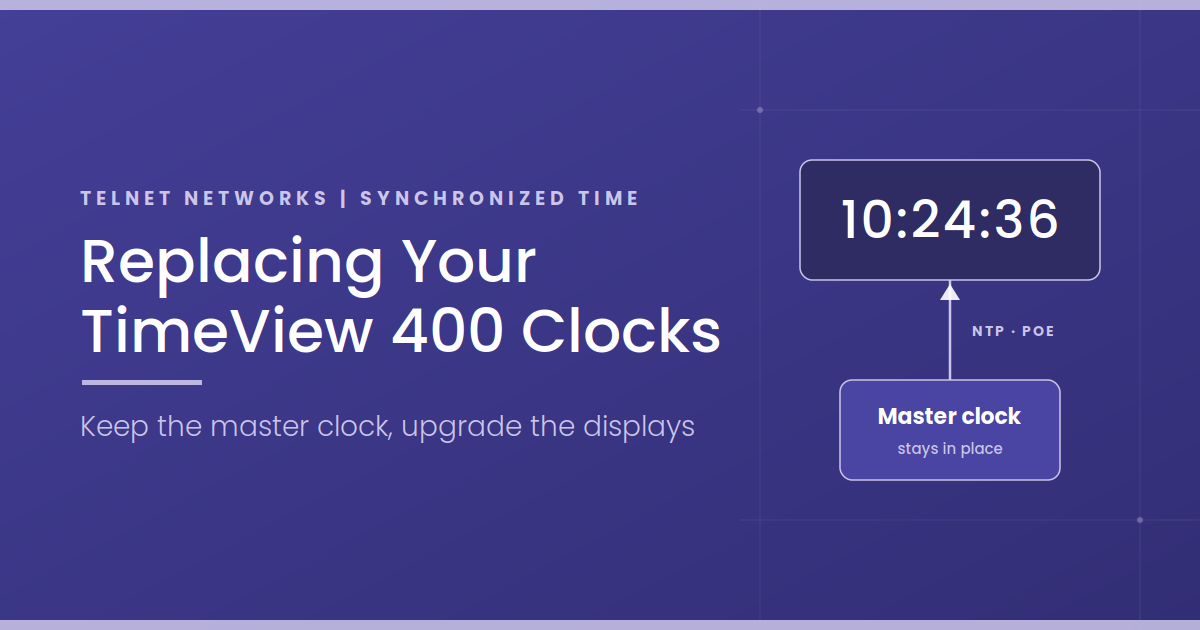
- Simple maintenance – clocks self-adjust for DST and remain in sync via NTP servers
- Flexible connectivity – multiple deployment options (IP-PoE, Wi-Fi, wireless)
- Reliability, quality & accuracy – ensuring campus-wide time uniformity
Telnet Networks was chosen as a trusted implementation partner due to the company’s proven track record in supporting higher education clients and deep expertise in Sapling solutions.
Key Outcomes
- Improved Time Uniformity Across Campus – Students and faculty now benefit from accurate, consistent timekeeping in classrooms, labs, and common spaces—minimizing tardiness, improving transitions, and reducing confusion.
- Reduced Overhead and Operational Maintenance – The centralized management interface enables IT and facilities staff to monitor clock status, push updates, and eliminate the need for manual time adjustments or battery replacements.
- Enhanced Foundation for Emergency Preparedness – In time-critical events like lockdowns, evacuations or fire drills, the system ensures staff and students respond in real-time with no discrepancies in time interpretation.
Download the full case study to see how this university achieved reliable, campus-wide synchronization and improved operational efficiency.