Skip to content
Network Instruments Connection Dynamics

Adjusting Clocks for Daylight Saving Time:


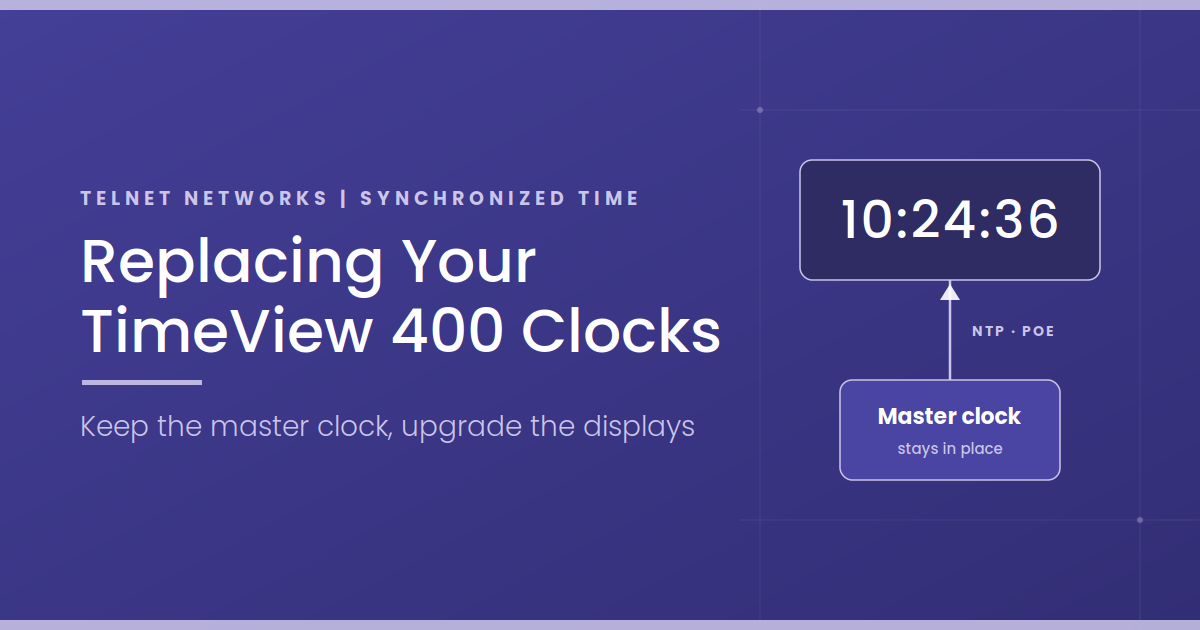
Daylight saving time comes twice a year, once in March and again in November. This can be a big hassle for maintenance teams, facility managers, IT staff, and anyone else in charge of keeping a building running smoothly. Adjusting for daylight saving time is easier if you have a synchronized clock system that performs DST updates automatically. Such a smooth transition means you can address other maintenance needs in the building, because who wants to spend time on time?

Calculate your lost time!

If keeping everyone in sync and on time is critical to your operations, then daylight saving time can be a big hassle. By adjusting each clock manually you’re spending a lot of time going from clock to clock adjusting each clock, and sometimes clocks are not easily accessible needing a ladder or lift, or waiting for a room to become available.

How Much Time can You Save?

If you have 100 clocks to manage and each clock takes 5 minutes to adjust, that takes you 8 hours twice a year to get everyone synchronized.

5 minutes/clock x 100 clocks x 2 DST events = 1000 minutes per year

1000 minutes ÷ 60 = 16 hours/Year

Its Time to Upgrade

Different technologies can be used to synchronize your clocks to meet any building requirement.

Related Posts

The Second Ring of C-8: What Selling to Critical Infrastructure Now Requires

The Second Ring of C-8: What Selling to Critical Infrastructure Now Requires

This article is a follow-up to our Bill C-8 overview post The contract renewal arrives from a customer you’ve served…
Keysight Network Visibility, Testing and Security: Where Each Piece Fits

Keysight Network Visibility, Testing and Security: Where Each Piece Fits

You can’t secure or troubleshoot traffic you can’t see. That’s an old line, but it has become a harder problem:…
Your GPUs Are Idle. It's Probably Not the GPUs' Fault.

Your GPUs Are Idle. It's Probably Not the GPUs' Fault.

Canada is building AI data centres at unprecedented scale. Here’s how to make sure the fabric underneath them actually performs…
Understanding & Operationalizing Bill C-8 as a Critical Infrastructure Operator

Understanding & Operationalizing Bill C-8 as a Critical Infrastructure Operator

On June 15, 2026, Bill C-8, An Act Respecting Cyber Security, received Royal Assent. After years of consultation, a false…
Data Diodes in ICS Environments: Why One-Way Visibility Is Becoming Non-Negotiable

Data Diodes in ICS Environments: Why One-Way Visibility Is Becoming Non-Negotiable

“You cannot secure what you cannot see.”  It’s a mantra we come back to often, because it’s true. Your security…