You can’t secure or troubleshoot traffic you can’t see. That’s an old line, but it has become a harder problem: hybrid cloud, encrypted east-west traffic, high-density AI data centres, and a monitoring toolset that costs more every year to keep fed with the right data.
Keysight Technologies builds most of what solves this. Their network visibility, security and test portfolio — built on the Ixia and NetOptics product lines — covers passive traffic access, intelligent packet distribution, inline failover protection, and pre-deployment threat validation.
Telnet Networks has been designing and deploying these products in Canadian networks for years. This guide is our take on where each piece actually fits: what problem it solves, what it costs you to skip it, and which environments suit it best.
The architecture in four lines
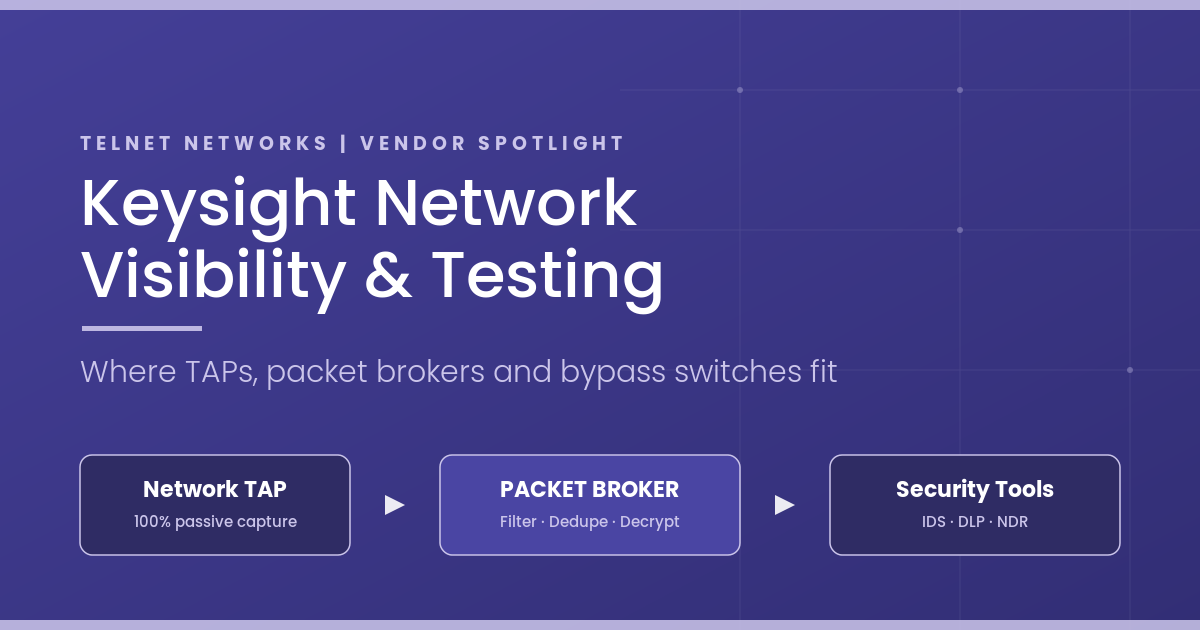
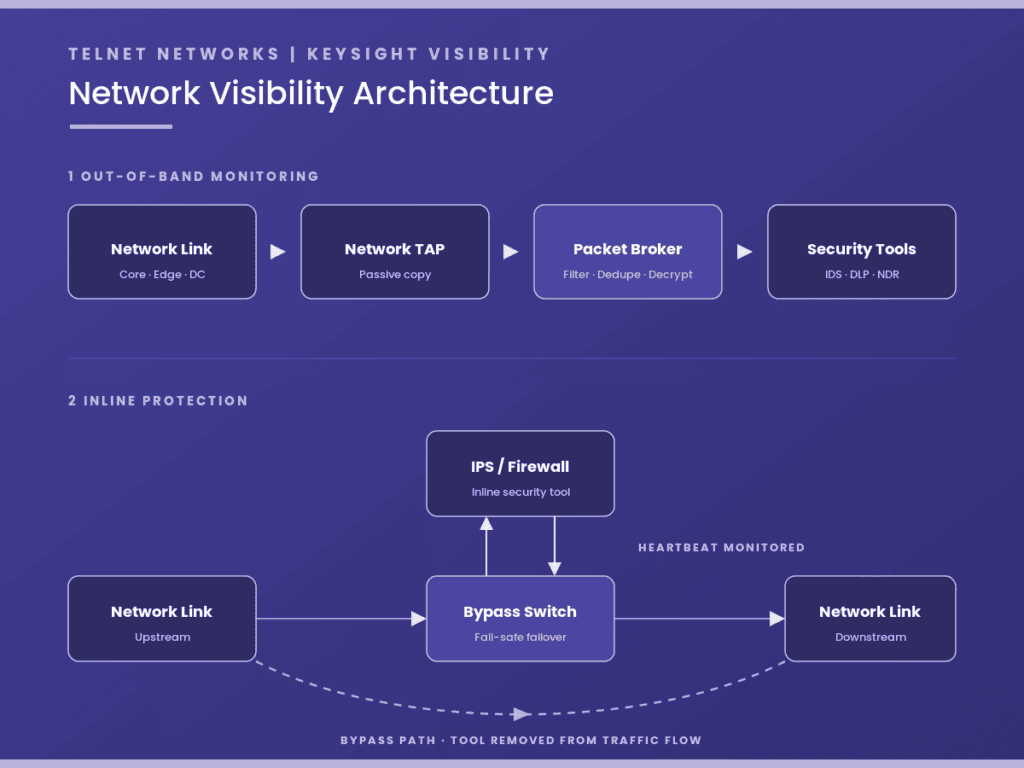
- Tap it. Network TAPs give you a passive copy of live traffic without touching your production switches.
- Broker it. Packet brokers filter, deduplicate and decrypt that traffic so each tool receives only what it needs.
- Protect it. Bypass switches keep the link up when an inline security tool fails or goes down for maintenance.
- Test it. BreakingPoint and Threat Simulator prove your defences hold up before an adversary finds out for you.
The Keysight Visibility and Security Portfolio
1. Network TAPs and Aggregators
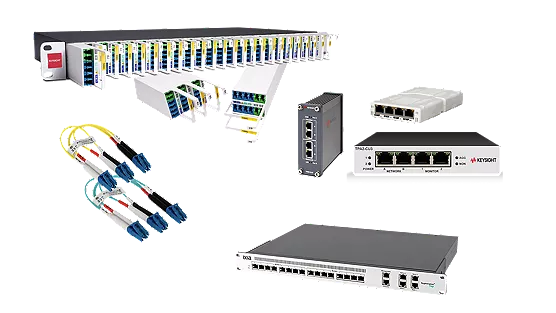
If you’re still feeding your monitoring infrastructure entirely from SPAN or mirror ports, you’re likely carrying blind spots you can’t see and adding load to switches that have better things to do. Network TAPs sit passively on the link and hand you a full copy of the traffic instead.
- Key features: 100% passive traffic capture from 1Gbps to 400Gbps, supporting single-mode, multi-mode and Cisco BiDi fibre. The Flex Tap VHD packs up to 36 taps into 1U. For industrial and outdoor deployments, ruggedized Tough TAPs provide the same passive access in environments that would kill standard hardware.
- Companion hardware: iLink Aggregators sit behind your TAPs to consolidate multi-link traffic into a smaller number of downstream tool connections — usually the cheapest way to avoid buying tool ports you don’t need.
- Best aligned for: Provincial and municipal utilities and other ICS/OT operators, where a passive tap is often the only monitoring method an operations group will approve on a control network. Also financial services, healthcare networks, and enterprise data centres where dropped packets aren’t an option.
Our take: the most common thing we find on a first site walk is a monitoring architecture that quietly outgrew its SPAN ports two or three refresh cycles ago. A proper tap plan is usually the least expensive fix on the table, and it’s the one that makes everything downstream work better.
2. Network Packet Brokers and Software-Defined Fabric
Once traffic is tapped, something has to decide where it goes. A packet broker is the traffic controller for your visibility layer — it makes sure each monitoring, forensics and security tool receives the data it needs and nothing it doesn’t.
- Key features: Built on a hardware-acceleration architecture Keysight describes as zero-packet-loss. The feature stacks layer up: NetStack (aggregation and line-rate filtering), PacketStack (deduplication and header stripping), SecureStack (inline and out-of-band SSL/TLS decryption), and AppStack (Layer 7 application awareness and geographic filtering).
- Key products: Vision ONE is the standalone platform for a first visibility deployment. Vision Edge 10S (E10S) suits remote offices and smaller data centres where rack space is tight. Vision Edge 400P handles enterprise cores, with 32 ports of 400Gbps processing in a compact form factor.
- Management overlays: Keysight Vision Orchestrator (KVO) and Ixia Fabric Controller (IFC) Clustering manage distributed multi-hop topologies from a single console, which matters as soon as you have visibility hardware in more than one site.
- Best aligned for: Telecoms and regional service providers, mid-to-large enterprises, government departments and higher education. If you’re trying to get more out of an expensive tool farm — IDS, DLP, NDR, firewalls — rather than buying more capacity, this is where to start.
Our take: before recommending a Vision platform we’ll usually audit what your existing tools are actually receiving. In most environments a meaningful share of what’s being sent to IDS and DLP is duplicate or irrelevant traffic — capacity you’re already paying for, twice.
3. Bypass Switches (Inline Protection)
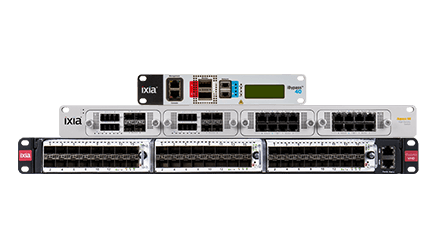
Putting a firewall or IPS directly in the traffic path is how you block threats. It’s also how you create a single point of failure. If that device freezes, loses power, or just needs a routine software update, the link goes with it.
Bypass switches solve this by acting as an automatic detour. If the security tool stops responding, the switch routes traffic around it at wire speed and the link stays up.
- Key features: Fail-safe automated inline protection. The switch monitors connected appliances using configurable “heartbeat” packets and reroutes instantly when one stops answering — so a tool outage doesn’t become a network outage.
- Topology: Built on the NetOptics legacy, with full support for both active-active and active-passive tool configurations at any scale.
- Key products: The Keysight iBypass family, including high-density and copper configurations such as iBypass Copper Gen 4, protects critical links without adding latency or configuration overhead.
- Best aligned for: Hospital networks and regional health authorities, Canadian financial institutions working to OSFI operational-resilience expectations, e-commerce platforms, and any mission-critical infrastructure where downtime maps directly to lost revenue or disrupted patient and customer operations.
Our take: the bypass switch is the least glamorous line item in a visibility design and the one clients thank us for most often. It typically pays for itself the first time an inline tool needs an unscheduled reboot during business hours.
4. Cloud Visibility and Performance Monitoring
When workloads move to public, private or hybrid cloud, most organizations lose the packet-level visibility they relied on for years on-premises. Keysight closes that gap by extending the same visibility intelligence into virtualized and software-defined environments, so your tools keep a single unified view no matter where the workload runs.
- Key features: Vision Edge OS on open-compute hardware, paired with virtual cloud taps, lets you monitor public, private and hybrid fabrics including AWS and Azure. For workloads that need precise timing, TimeKeeper® provides verifiable clock synchronization.
- Best aligned for: Organizations partway through a cloud migration who still need on-premises-grade packet visibility, SaaS providers, and any environment with microsecond timing or timestamp-compliance requirements.
A note on data residency: for public sector, healthcare and regulated financial clients, where visibility and telemetry data lives is as much of a design constraint as throughput. Cloud visibility deployments need to account for it from the start, not as a retrofit. Telnet supports Canadian deployments end to end and can help scope an architecture that keeps monitoring data where your policy requires it.
5. Network Test and Security Validation
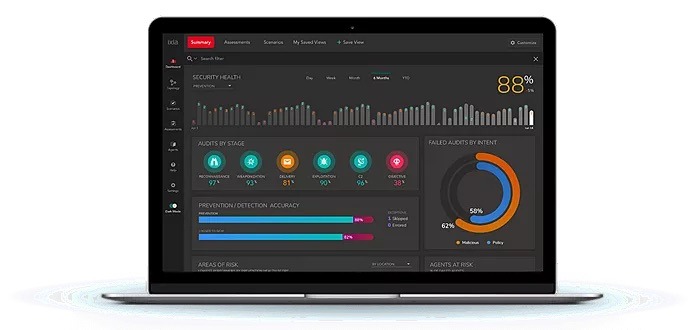
Visibility is half the job. The other half is knowing how your defences actually behave under pressure — before a real adversary finds out for you.
Plenty of organizations run on baseline configurations and hope for the best, with no evidence of how the security stack performs under load. Keysight’s test portfolio lets you safely generate large-scale application traffic and simulate real attack techniques inside your own environment, so your team can demonstrate the defences work rather than assume they do.
- Key features: BreakingPoint and BreakingPoint Cloud run application stress tests and simulate real-world attack traffic safely. The SaaS-based Threat Simulator runs continuous Breach and Attack Simulation (BAS) against your live environment without disrupting it. Both are fed by Keysight’s Application and Threat Intelligence (ATI) team, which maintains the threat and application definitions.
- Best aligned for: SecOps and cybersecurity engineering teams, QA and lab environments, and compliance functions that need documented evidence of control effectiveness rather than a configuration screenshot.
Our take: for teams building a validation practice from scratch, we’ll usually suggest starting with a scoped BreakingPoint engagement rather than a full platform purchase. It’s a faster way to find out what you’d actually use.
Quick Reference
| Product category | Primary focus | Best use case |
| Network TAPs | Passive, raw packet capture | Replacing overloaded SPAN ports; monitoring OT/ICS links without touching the control network |
| Packet Brokers (Vision series) | Filtering, deduplication, SSL decryption, tool load balancing | Getting more out of an existing tool farm; sending targeted traffic to specific appliances |
| Bypass Switches (iBypass) | Inline high availability and tool failover | Keeping critical links up when an inline firewall or IPS fails or needs patching |
| Test Suite (BreakingPoint / Threat Simulator) | Threat simulation and network stress testing | Proving control effectiveness; testing resilience before production deployment |
Where to start
Building a visibility layer that holds up requires the right foundation — and most of the cost of getting it wrong shows up later, in tool licences you didn’t need and blind spots you didn’t know about.
As a Keysight partner, Telnet Networks can help you assess your current topology, design a visibility architecture that fits your environment, and choose the right mix of TAPs, packet brokers and test platforms for the budget you have.
Two ways to start:
- Not ready to buy anything yet? Ask us for a network visibility assessment. We’ll review your current TAP and SPAN architecture and tell you where the gaps are.
- Have a specific project in mind? Contact our team to talk to a technical specialist or request a proof-of-concept design built for your environment.