A Practical Guide to Bodet Analog Clocks

A Practical Guide to Bodet Analog Clocks

Designed and manufactured in France, Bodet analogue clocks are designed to deliver precise, synchronized time across professional environments where accuracy and consistency are essential and style is valued. More than simple wall clocks, they operate as part of a complete timekeeping system that ensures every clock in a facility displays the same reliable time without the need for manual adjustment.

Built for durability, flexibility and striking presentation, Bodet analogue clocks are suited for a wide range of applications including healthcare, education, corporate, and industrial settings. With multiple configurations, clear readability, and low maintenance requirements, they provide a dependable long-term solution for organizations looking to standardize and simplify time management.

The Profil 900 Series: Versatility Meets Modern Design

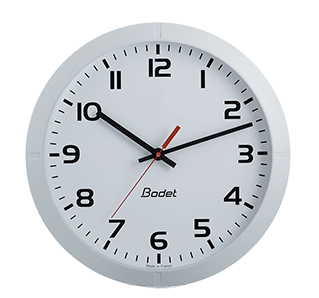
The Profil 900 series is Bodet’s most popular range, designed for indoor environments where aesthetics and readability are paramount.
Key Features:

Design: These clocks feature a contemporary, slimline look with a high-quality polymer casing.

Dimensions: Available in three sizes (30cm, 40cm, and 60cm diameters) to suit everything from a small office to a large school gymnasium.

Customization: You can choose between various dial models (figures, markers, or DIN railroad style) and casing colors (white, black, chrome, or aluminum).

Flexible installation: Available in wall-mounted, double-sided, and ceiling-mounted formats to suit a variety of architectural layouts

Common Applications: The 900 series is the “workhorse” for Education, Healthcare, and Corporate Offices. Their clean design allows them to blend into modern interiors while providing perfect legibility up to 60 meters away.

Profil 700 Series Analogue Clocks

The Profil 700 Series: Rugged Durability
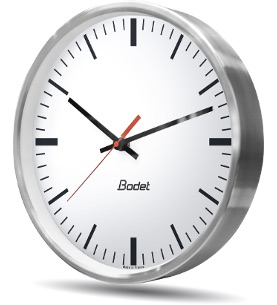
When the environment gets tough, the Profil 700 series steps up. These clocks are designed with a heavy-duty metal casing and tempered glass, making them significantly more robust than their 900-series counterparts.

Key Features:

  • Construction: Steel casing with an IK09 impact rating, meaning they can withstand significant physical force.
  • Security: These clocks feature a locking system that makes them nearly impossible to remove without specialized tools—a must-have for high-traffic public areas.
  • Sizes: Available in 30cm and 40cm diameters.
  • Multiple installation options: Available in wall-mounted configurations to suit a wide range of indoor environments

Applications: The 700 series is built for Transportation Hubs (train stations/airports/bus stations), Industrial Facilities, and Correctional Institutions. If there is a risk of impact or vandalism, the 700 series is the definitive choice.

Profil 930L Series

Bodet Profil 930L series is a compact, eco-designed analogue clock solution built for environments that need reliable time display with minimal energy use. It is especially well suited for sustainable buildings, remote locations, and sites where access to wired power is limited.

Combining sustainability, flexibility, and dependable synchronization, the Profil 930L series is a strong choice for organizations looking to reduce energy consumption while maintaining accurate, consistent analogue timekeeping.
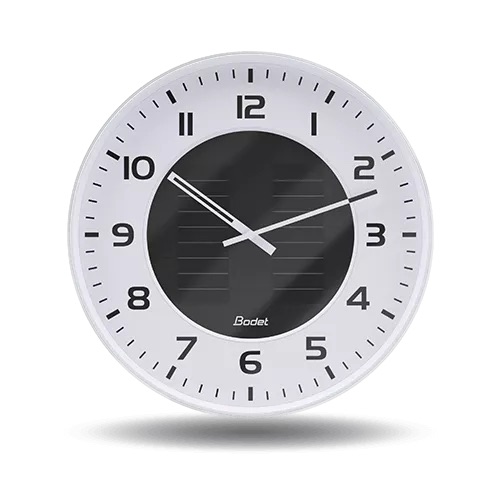
Eco-powered design: Solar-assisted operation reduces dependency on traditional power sources and supports energy-efficient installations
Standalone or synchronized use: Can operate independently or integrate into centralized time systems for facility-wide accuracy
Compact and discreet format: Slim design allows easy integration into modern architectural spaces without visual disruption
Flexible deployment: Ideal for offices, public buildings, and sites where low-maintenance timekeeping is essential
Reliable performance: Built for continuous operation with minimal servicing requirements

Across the Profil 700, 900, and 930L series, Bodet delivers analogue clock solutions designed to meet a wide range of operational and environmental needs while maintaining consistent synchronization, readability, and reliability. With each series offering specific strengths for different applications, the focus shifts from product selection to how these clocks are deployed within a facility. The following sections outline the key options for mounting, visibility, power, synchronization, and real-world application.

Mounting and Installation Options

Bodet analogue clocks can be installed in several configurations to suit different building layouts and visibility needs:

  • Wall-mounted clocks for standard rooms and offices
  • Double-sided clocks for corridors and open areas where visibility from multiple directions is required
  • Ceiling-mounted clocks for large or crowded spaces with limited wall access
  • Mast or bracket-mounted clocks for outdoor and transport environments

These options ensure consistent time visibility across a wide variety of facility types.

Dial Design and Visibility

Visibility and readability are key design priorities across all Bodet analogue clocks:

  • Dial styles include Arabic numerals, minute markers, and DIN-standard layouts
  • Time display options include hours/minutes or hours/minutes/seconds
  • Multiple dial sizes ranging from approximately 30 cm to 100 cm depending on application
  • Designed for both close-range indoor viewing and long-distance public visibility

Power Supply Options

Bodet analogue clocks support multiple power configurations to match installation requirements:

  • Indoor models powered by battery, low-voltage (ELV), or PoE
  • Outdoor models powered by 120V or PoE
  • Specialized models available with solar power options, such as the Profil 930L

Synchronization Methods

All Bodet analogue clocks are designed for precise, centralized time synchronization:

Indoor, Outdoor, and Industrial Applications

Bodet analogue clocks are engineered to perform across a wide range of environments:

  • Indoor use in offices, classrooms, healthcare rooms, and commercial buildings
  • Outdoor installations with weather-resistant housings for public spaces and transport areas
  • Industrial and transport environments requiring reinforced durability and high reliability

If you’re looking to improve time synchronization and visibility across your facility, contact our sales team to learn more about Bodet analog clock solutions and find the right configuration for your environment.

What Is a Master Clock and Why Does It Matter?

What Is a Master Clock and Why Does It Matter?

Modern organizations rely on precise time synchronization to keep operations running smoothly and consistently. Critical systems across industries such as finance, emergency services, manufacturing, and healthcare depend on devices sharing an exact, unified time reference. This ensures events are recorded accurately, processes remain coordinated, and systems operate reliably.

In any time-sensitive environment, two fundamental challenges must be addressed:

1. Organizations must determine which clock will serve as the authoritative time reference for all connected systems. This source must be highly accurate and reliable so that every device in the network can trust the time it provides.

2. Determining how that time will be distributed across the network to other devices. Servers, control systems, monitoring tools, and facility clocks all need to receive the same time reference consistently and with minimal delay to maintain synchronization.

A master clock system solves both challenges by acting as a centralized source of precise time. It synchronizes with a trusted reference and distributes that time across an entire facility or enterprise, ensuring all connected systems operate on the same timeline.

What Is a Master Clock?

A master clock, sometimes referred to as a time server,  is a highly precise timekeeping device that serves as the authoritative source of time for an entire network or facility. It receives its time from a trusted reference and ensures that all connected systems, often called secondary or slave clocks, are synchronized to the exact same time. This level of synchronization is critical in environments where even microsecond discrepancies can impact operations, including financial trading, telecommunications, industrial automation, and healthcare systems.

Master clocks typically obtain their reference time from highly reliable sources such as:

GPS or GNSS satellites – Globally recognized, highly accurate time signals
External
NTP (Network Time Protocol) servers Standardized network-based time
Local atomic clocks or high-stability oscillators- Independent precision timekeeping
Other trusted time standards-
Based on organizational or regulatory requirements

Once a master clock acquires an accurate time reference, it distributes that time to all connected devices. This ensures that every system across the network operates in perfect synchrony, minimizing errors, maintaining compliance, and supporting seamless coordination across complex operations.

How Master Clocks Distribute Time

Modern master clock systems provide multiple methods for distributing precise time across an organization’s infrastructure, tailored to different environments and requirements.

Network-Based Time Distribution
Many systems synchronize time over IP networks using protocols such as:

NTP (Network Time Protocol) – commonly used to keep servers, workstations, and IT systems in sync

PTP (Precision Time Protocol) – provides sub-microsecond accuracy for industries like telecommunications, finance, and broadcasting

Wired Timing Signals – In specialized environments, master clocks can distribute time via copper or fiber connections using formats such as IRIG or other digital timing signals. This method is often used in aerospace, defense, and broadcast applications where extremely precise synchronization is required.

Wireless Clock SystemsSome master clock systems transmit time wirelessly to clocks throughout a facility, often using readily available unlicensed spectrum. This approach reduces installation complexity by eliminating extensive wiring while still maintaining accurate synchronization across all display clocks.

Why Accurate Time Synchronization Matters

Consistent time across devices and systems is essential wherever precision and order matter. Even small discrepancies can lead to data inconsistencies, failed transactions, security gaps, or compliance risks.

Organizations rely on synchronized time for a wide range of critical functions, including accurate event logging and security auditing, financial transactions and regulatory reporting, emergency response coordination, industrial automation, telecommunications, and healthcare systems. When all systems share a common time reference, teams can correlate events more effectively, troubleshoot issues faster, and maintain a clear, traceable record of operations.

Reliability and Redundancy

Modern master clock systems are built with resilience at their core. In environments where timing is critical, losing access to a primary reference source such as GPS cannot mean losing synchronization. To address this, these systems are designed with built-in redundancy that allows them to continue operating even when external signals are temporarily unavailable.

When a primary time source is lost, the system enters what is known as a holdover state, relying on a high-stability internal oscillator to maintain accurate time. These oscillators are engineered to minimize drift, ensuring that synchronization remains consistent across connected systems until the reference signal is restored. This level of reliability is essential for maintaining operational continuity and avoiding disruptions in time-sensitive applications.

The Role of Master Clocks in Modern Networks

While synchronized clocks were once primarily used for facility displays, today’s master clocks play a far more critical role. They act as the central timing authority across both operational technology and IT environments, supporting a wide range of interconnected systems.

Modern solutions integrate with network protocols, automation platforms, and monitoring tools to provide a unified and traceable time source across entire organizations. This enables accurate system logging, secure and verifiable timestamps, consistent synchronization across distributed networks, and support for advanced timing standards such as PTP.

As organizations continue to adopt distributed architectures and time-sensitive applications, the need for precise, reliable, and traceable time synchronization continues to grow. Master clock systems have become a foundational component of modern digital infrastructure.

Leading Master Clock Manufacturers

When evaluating master clock solutions, it’s important to consider the strengths and focus areas of different manufacturers. While all aim to deliver accurate and reliable time synchronization, each brings a unique approach based on target industries, deployment environments, and feature sets.

Safran

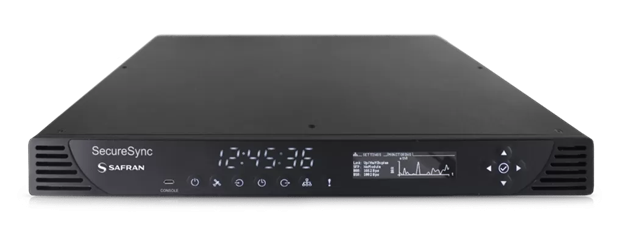
securesync gps time servers

Safran is widely recognized for its high-precision timing solutions designed for mission-critical and regulated environments. Its master clocks and time servers deliver extremely accurate synchronization, often supporting advanced standards like Precision Time Protocol (PTP), multi-constellation GNSS inputs, and enhanced security features. These systems are commonly used in sectors such as telecommunications, finance, aerospace, and defense, where timing accuracy and resilience are essential.

Sapling

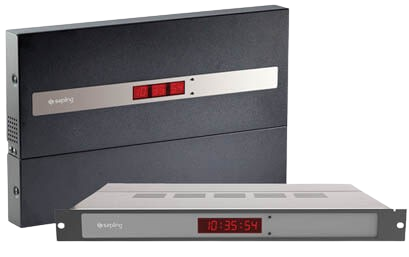
sapling master clocks

Sapling specializes in master clocks for time display units and systems including healthcare, education, and corporate facilities. Their master clocks serve as the central time source, delivering precise, reliable synchronization across both wired and wireless networks. Known for easy deployment and flexible configuration, Sapling’s solutions integrate seamlessly with existing infrastructure, while their traditional clock systems complement modern networked setups—making them ideal for organizations seeking accurate, resilient timekeeping with straightforward hardware management.

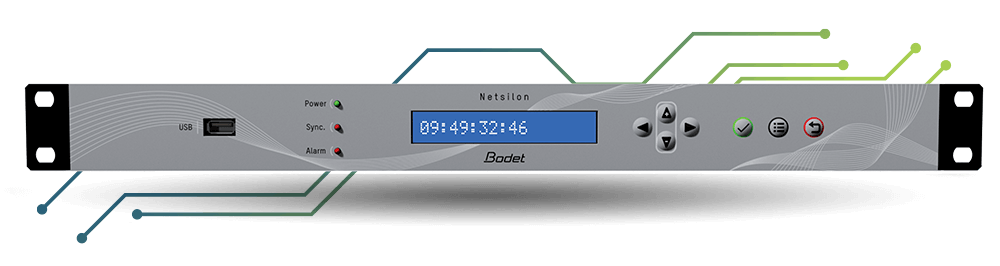
Bodet

Bodet’s cost effective solutions provide a wide range of time synchronization solutions that bridge industrial performance with user-friendly design. Their master clocks support both NTP and PTP distribution, making them suitable for environments that require precise timing across IT and operational systems. Bodet is particularly strong in sectors like transportation, manufacturing, and public infrastructure, where cost, reliability, modularity, and scalability are key considerations.

Choosing the right master clock solution depends on your environment’s specific needs, including accuracy requirements, network complexity, regulatory considerations, and scalability. Whether synchronizing display clocks across a campus or ensuring precise timestamps across enterprise systems, the right master clock architecture provides the reliable, centralized timing needed to support both current operations and future growth. Contact our sales team to discuss the best synchronized time solution for your organization.

Two problems need to be solved in any time-related application:

StableNet Network Management Solutions 5
  1. Which clock is used as the reference for all other clocks
  2. How to transfer the time from the reference clock to all other clocks

The solution is to use a master clock as your reference. Master clock systems are used in a wide variety of applications and industries including aerospace and defence, broadcast, radio and telecom, network systems, financial services, emergency operations, call centers, and healthcare — essentially anywhere reliability of data and signals are paramount.

What is a master clock?  

A master clock takes one or more precise timing reference signals as inputs, and then converts and distributes those timing references to other devices. The method by which the accuracy of the master clock is transferred to other secondary clocks is known as synchronization. Typically, GPS satellite signals are utilized for synchronization to ensure accurate time, but other references may be used such as local atomic clocks or other time standards.

A core feature of all master clock systems is that they accept precise timing reference signals as input. It is a rare case for a master clock to be free-running and not continuously synchronized, or at least compared against an external reference. Orolia’s SecureSync modular time and frequency synchronization system can accept over 14 different signal types to discipline its local clock. This system can then generate a similar number of signal types to synchronize other devices. In case of loss of the external reference (or any redundant references), the local clock maintains timing accuracy using a local clock oscillator until the reference(s) can be restored. Several different clock oscillators are offered depending on the accuracy required during the “hold over” period.

Network master clocks can distribute their timing references over local or wide area networks. Master clocks with wireless transmitters enable synchronization of devices like display clocks without having to run wires between them for the synchronization signal. There are also highly accurate master clock solutions that utilize copper or fibre connections for precise analog and digital signal distribution, such as IRIG timecode signals.

Orolia offers a variety of master clock systems to meet the requirements for your application of accurate time. Learn more about flexible SecureSync Master Clocks