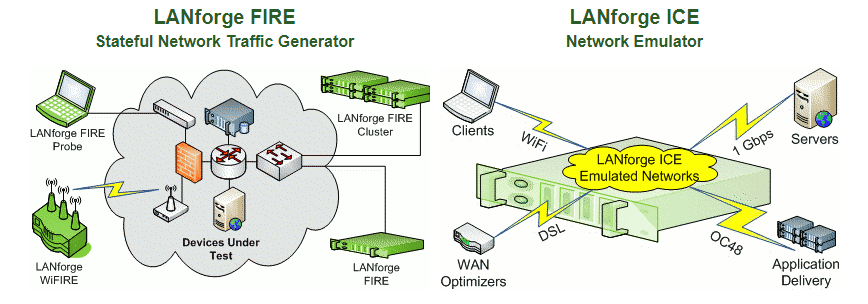
Release 5.3.8 adds REST automation API support, improved wave-2 WiFi performance and stability, an improved RF RADAR generator and more. See the Release Notes for more details.
Click here for more releases.
New Features & Improvements Release 5.3.8 (November 13, 2018)
- Support Virtual Router Function (VRF) in kernel 4.16 and higher. This is a different way to do virtual-routing, and among other things, gives the ability to have multiple interfaces with the same IP address. (File-IO NFS, SMB, CIFS is broken on VRF, most other features work fine.)
- Fix token parsing in CLI commands, both external and internal. This fixes trying to set the SSID to my-ssid-‘ for instance. See CLI user-guide help for details.
- Support configuring some resource-wide options, including configuring how to bring up interfaces.
- WiFi: Normall LANforge will share scan results among all stations on a radio. This significantly speeds up association time. But, in case someone wants to do a scan-per-station, that option is now available, and configurable on the WiFi Radios.
- Support explicitly migrating virtual stations to new radios. Example CLI command: admin req_migrate 1.2.sta30 1.1.wiphy1 Support this in Batch-Modify in the GUI as well.
- Support parent-mac patterns in CLI for add_sta, add_vap, set_port and add_mvlan
- GUI: REST API support for creating, modifying, deleting and viewing ports and other objects.
- GUI: Support -daemon mode so that the GUI can act as a service for REST clients without consuming as much memory and CPU resources.
- Attenuators: Improve discovery logic for attenuators.
- LANforge-Attenuator: Add ‘no_lcd’ option to suppress updating LCD when changing the attenuation configuration over the serial interface. This decreases time to change attenuation from about 160ms to about 8ms. This should help those wanting high-speed scripting of the attenuator.
- RF-Generator: Support new CT712 RF and RADAR generator. This reliably triggers RADAR detection on modern APs.
- WiFi: Allow disabling the operating-class IE in association attempts (this can work around bugs that seem to be in some APs). When enabled, the IE now correctly pays attention to virtual station settings to limit VHT and HT modes, and band restriction.
- WiFi: Support up to 32 VAP interfaces on the /a/b/g/n ath9k NIC.
- Support AUTO-UDP-NAT option for Layer-3 UDP and UDP-IPV6 connections. This tells LANforge to use the source-address of received frames as the destination, which should allow it to work through NAT networks.
- Improve GUI hot-key shortcuts, especially on the port-mgr tab.
- Allow GUI to discover LANforge resources as well as managers.
- WiFi: Improve transmit performance on the wave-2 4×4 NIC. The firmware rate-control algorithm has been improved to be more efficient. In some cases, throughput is around 50% better.
- Beta support for running LANforge on Netgear r7800 systems using OpenWRT. This may be a good low-powered platform for creating large clusters of LANforge systems for MU-MIMO testing and other scenarios that benefit from lots of real radios. Bug Fixes
- Fix problem where bond interfaces were not properly re-created on reboot.
- Fix ‘bind-mgt’ option. No obvious work-around for older broken systems, other than don’t use the feature. • Fix memory leaks in the ‘gnuserver’ helper process, and the GUI. Known Limitations
- VRF and File-IO: The 4.16 kernel supports VRF, but NFS, CIFS, and SMB File-IO traffic types do not support VRF at this time. So, you have to disable VRF to run File-IO:
touch /home/lanforge/LF_NO_USE_VRF; reboot