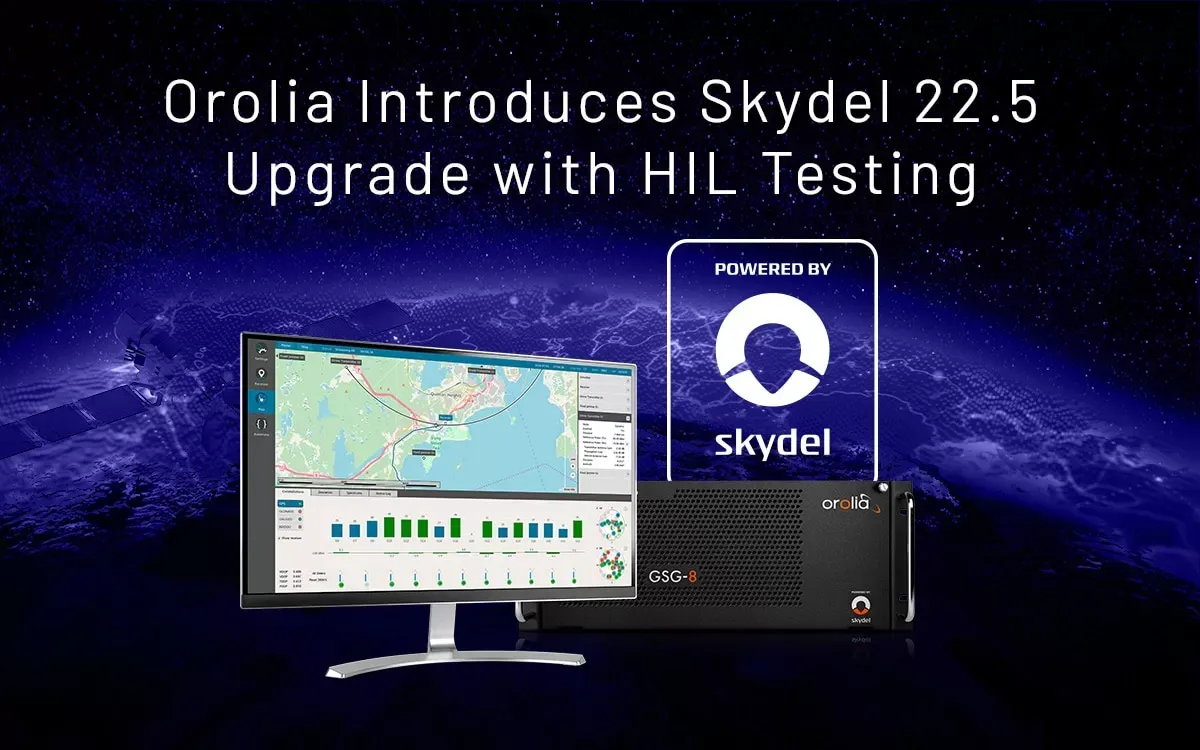
Orolia Releases New Skydel GNSS Simulation Software Upgrade Featuring Advanced Hardware-in-the-Loop Testing Solution
Skydel 22.5 Brings Very-Low to Zero-Effective-Latency and Enhanced Visualization Tools
Orolia has released Skydel 22.5, a significant software upgrade to its Skydel simulation product line that features advanced Hardware-in-the-Loop (HIL) testing solutions providing very low to zero-effective-latency. The enhanced visualization tools can monitor internal latency through real-time curves showing when the data is generated and sent to the RF signal. Users can also review the transmission of HIL packets for optimizing the entire network’s latency, checking its stability (jitter), and that data is available and used at the right time in Skydel.
HIL testing is an essential step in the verification process of the Model-Based Design (MBD) approach because it involves all the hardware and software that will be used operationally. HIL verification can test a standalone Device-Under-Test (DUT) or, more generally, an entire complex system consisting of multiple DUTs in both open and closed loop architectures.
“The vast majority of problems encountered by engineers on HIL systems are related to poor control of the latency of the entire simulation chain, as they are insufficiently accessible, transparent and controlled on the competing systems,” said Pierre-Marie Le Veel, Principal System Architect and Product Manager for GNSS Simulation. “Thanks to these tools, our high-end performance, and well-known intuitive automation, Skydel dramatically reduces the implementation time of a HIL system (which can be very significant) and, therefore, the project’s overall cost.”
In addition to these tools, Skydel implements modern extrapolation algorithms that achieve zero-effective-latency. These algorithms make it possible to keep position errors negligible, even for equipment with very high dynamics used in national defense applications such as missiles, rockets, and guided shells.
“These advanced HIL algorithms and tools are available – and with the same performance – on our Wavefront simulation systems to test Controlled Reception Pattern Antenna (CRPA) systems,” Le Veel added.
Additional constellations, signal types, and options such as Real Time Kinematic (RTK) and Multi-Instance are available along with dedicated bundled simulation starter packages for automotive.
The upgrade is available at no additional cost for existing users operating Skydel 22.4. Application notes, support documents, and tutorials are available online.
About Orolia
Orolia is the world leader in Resilient Positioning, Navigation and Timing (PNT) solutions that improve the reliability, performance and safety of critical, remote or high-risk operations, even in GPS/GNSS denied environments. Orolia provides virtually fail-safe GNSS and PNT solutions for military and commercial applications worldwide. www.orolia.com