Here is a renewal many teams will recognize. It is an illustration, not a customer story. The core moves from 40G to 100G. The upgrade was for headroom, and the traffic itself has barely changed. A few weeks later, the quote for the NDR and IDS sensors comes back larger anyway. The sensors need 100G interfaces to connect to the new links, the next appliance class to carry them, and in some cases a licence tied to the speed of the port. Nothing about what the tools inspect is different. The quote followed the pipe.
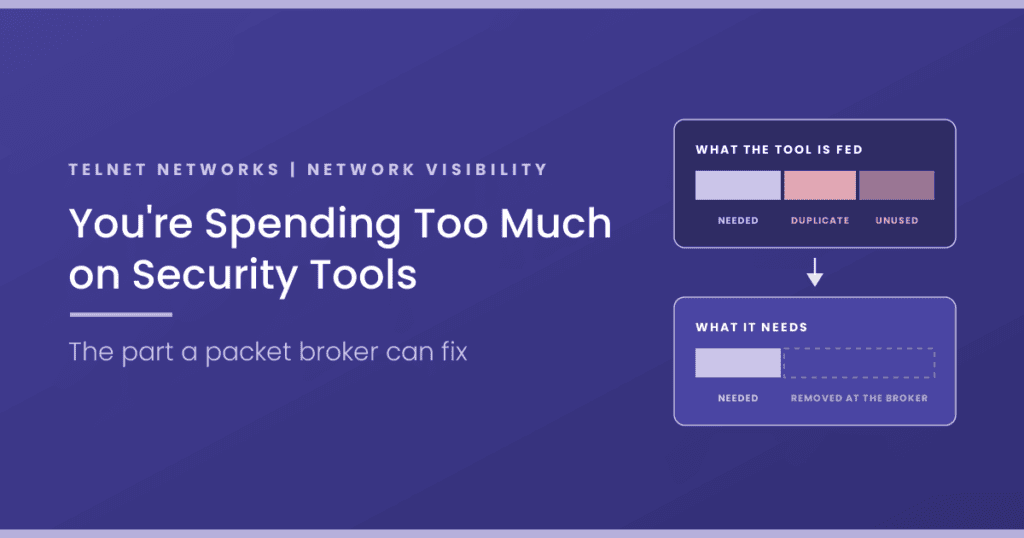
That is one of two ways network security tools end up costing more than they should. Some costs follow the connection: the speed of the port, the class of the appliance, the number of links that each need a sensor. Others follow the volume: throughput licences, SIEM ingest, capture storage. Much of that volume is traffic the tool does not need: duplicate packets, flows no rule will ever match, payload a metadata tool never reads.
A packet broker works on both. It sits between the network and the tools, so a tool no longer has to match the link it monitors, and it removes unneeded traffic before it reaches the meter. If the goal is to reduce security tool costs, a packet broker is one of the few options that changes what is being measured instead of the unit price.
This post covers where the money goes, which part a broker can cut, which part it cannot, and how to cut without creating a blind spot.
First, what a packet broker won’t fix
A packet broker changes what packet-consuming tools receive and where they receive it. That is all it does, and it is a smaller slice of the security budget than the headline suggests.
It does nothing for endpoint, identity, email or SaaS security spend. An IBM Institute for Business Value study with Palo Alto Networks, a platform vendor with an interest in the answer, found organizations running an average of 83 security solutions from 29 vendors. Only a handful of those sit on a TAP or a SPAN port.
For a SIEM, a broker reduces only the network-derived share of ingest. In many organizations that share is small next to endpoint, cloud and identity logs. For those logs, the SIEM’s own lower-cost storage tiers (Microsoft Sentinel’s data lake tier, for example) or a log pipeline in front of the SIEM are the better lever.
A broker also rarely pays back for a single tool on low-speed links. In public cloud, the traffic mirroring is often the cost in its own right.
If most of your spend sits in those places, this post is not your answer.
How network security tools charge you
The tools that do sit on the network are charged for in two broad ways. Some costs follow the connection and some follow the volume. The difference matters more than the price, because it decides which changes lower the bill at all.
| What is metered | Follows | Typical tools | What pushes it up |
|---|---|---|---|
| Port speed of the probe connection | The connection | Some NDR products | Link speed, whatever the load |
| Appliance capacity and count | The connection | Inline IPS, DLP, packet capture, NPM probes | Interface speed, peak load, number of monitored links |
| Sensor throughput (Gbps) | The volume | NDR, IDS | Traffic delivered to the sensor |
| Ingest volume (GB per day) | The volume | SIEM | Every event and flow record forwarded |
| Retention | The volume | Packet capture storage | Captured volume multiplied by days kept |
A link upgrade with flat traffic leaves the volume rows alone. It hits the connection rows, which is what happened in the opening example.
Sensor throughput. Corelight is a useful worked example because its terms are public. As of November 2026, Corelight’s product-specific terms measure sensor throughput in Gbps on a five-minute average, calculated after the sensor’s own input filtering. That detail changes where a broker helps. Traffic the sensor filters out is already uncounted, so filtering upstream that the sensor could have done itself saves nothing on the licence. The saving on a meter like this comes from what the sensor no longer has to receive at all: fewer duplicate packets reaching Corelight, sensor hardware sized to the filtered feed, and fewer sensors for the same links. On a throughput meter, a faster link changes nothing until the traffic grows. Other NDR products license by the port speed of the probe connection, so there a faster link means a bigger licence whether or not the traffic grew.
Ingest volume. As of November 2026, Microsoft Sentinel bills its analytics tier per gigabyte ingested, with commitment tiers from 100 to 50,000 GB per day. For network-derived data, the way to reduce Microsoft Sentinel ingestion costs is to send fewer and leaner records. Splunk is less direct. It offers several pricing models, including ingest pricing in GB per day and workload pricing based on compute. On a workload model, cutting ingest lowers the bill less directly, so check which meter your contract uses before expecting your Splunk licence cost for network data to fall.
The hidden ones. Some costs never appear as a line item: a tool port for every monitored link, a tool refresh forced by a link upgrade, and analyst hours spent closing the same alert twice. Retention is a cost driver too, but storage arithmetic is a subject for another post.
One technical point most budget holders miss: a tapped full-duplex link produces a separate monitoring stream for each direction. A 100G link can therefore present up to 200 Gbps of monitor traffic at peak. Tools are sized to that peak, not to the link’s average.
Six levers, matched to the cost they cut
A broker is not one feature. It is a set of techniques, and each one maps to a specific cost driver. Two of them separate the tool from the link, three trim the feed, and one removes repeated work. Our Keysight overview shows where the broker layer sits in a visibility architecture. The same applies for our other network visibility partners.
Before and after: network links wired directly to every security tool, compared with TAPs feeding a packet broker that delivers filtered feeds to right-sized tools
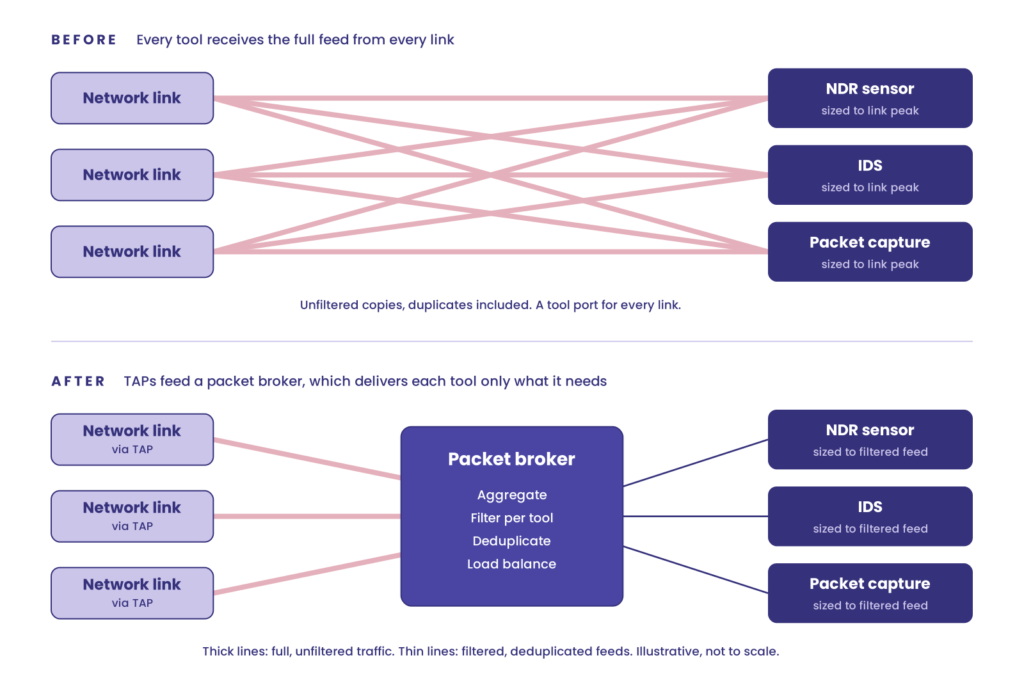
Illustrative. Thick lines are full, unfiltered traffic; thin lines are filtered, deduplicated feeds.
| Lever | Works on | Cost driver it cuts | What it saves |
|---|---|---|---|
| Aggregation and speed conversion | The connection | Tool ports, sensor count, port-speed licences | Sensors per link, refreshes forced by link upgrades |
| Load balancing | The connection | Appliance class | The step up to the next model |
| Per-tool filtering | The volume | Throughput tier, appliance count | Capacity spent on traffic the tool cannot use |
| Deduplication | The volume | Throughput, duplicate ingest | Licence headroom and analyst time |
| Packet slicing and header stripping | The volume | Throughput, storage | Bytes a header-only tool never reads |
| Do it once, feed many | Repeated work | Per-tool processing | Decryption and metadata work done in every tool |
- Aggregation and speed conversion. Many lightly used links are combined onto fewer tool ports, so one sensor covers links that would each have needed their own. A 100G link can also be delivered to a 10G tool, once the feed has been filtered to fit. Aggregation does not shrink a throughput licence, because the total traffic is the same. It cuts the number of sensors and ports, and it stops the tool having to match the link.
- Load balancing. One large stream is spread across several smaller tools with N+1 failover, in place of one larger appliance.
- Per-tool filtering. Each tool gets only the traffic its job needs. Backup and storage replication, for example, can be kept away from an IDS that has no rules for them.
- Deduplication. SPAN ports, and capturing the same packet at more than one point, both create copies. We covered the mechanics in Resolving the Challenge of Duplicate Packets. Removing copies cuts throughput, duplicate events in the SIEM, and duplicate alerts.
- Packet slicing and header stripping. Slicing truncates the payload for tools that only read headers. Stripping removes tunnel and VLAN encapsulation so tools can parse what is inside.
- Do it once, feed many. Decryption, metadata or IPFIX generation, and timestamping happen once at the broker and not inside every tool. Our post on Encrypted Client Hello makes the metadata argument in full.
How much any of this saves varies widely from one network to the next. The figures in circulation come from vendors and most are years old. The only number worth putting in a business case is one you have measured.
Where each lever quietly removes evidence
Every technique that removes traffic can also remove evidence. “Without reducing visibility” is a design discipline, not a feature. This is where a cost project goes wrong, usually without anyone noticing until an investigation needs the packets that were never delivered.
- Filtering. “Known-good” traffic is a favourite exfiltration path, precisely because nobody inspects it. Filter per tool against a written purpose, never globally, and review the filters whenever the network changes.
- Deduplication. A window set too wide can remove legitimate retransmissions, which performance tools need to see. Security and performance tools may need different settings on the same broker.
- Slicing. It removes the payload that signature-based IDS rules and file extraction depend on. Never slice the feed to a tool that inspects payload.
- Header stripping. It can remove the VLAN or tunnel context an analyst needs to attribute an event to a tenant, site or segment. Preserve that context or re-tag it.
- Load balancing. Both directions of a session must land on the same tool, which means symmetric hashing. Without it, stateful detection breaks. Check what happens to sessions when a tool fails over.
- Speed conversion. If the filtered traffic bursts past the delivery port, the broker drops the excess, and unless someone is watching its counters, nobody is told. Size to peak and alarm on broker egress drops.
- Sampling. Never for security tools. A sampled feed is a blind spot with a schedule.
Prove nothing was lost
A cheaper design is only better if it sees what the old one saw. That has to be measured before and after, not asserted.
- Baseline first. For each tool, record what it receives today: volume, the share that is duplicate, and the drop counters on the tool and on any SPAN port feeding it.
- Compare after the change. Check broker egress drops and tool drops, then compare alert and detection volumes over a matching period. A fall in duplicate alerts is expected. A fall in distinct detections needs an explanation.
- Draw the coverage map. List which links each tool sees, before and after. A link that disappears from the map should be a decision, not an accident.
- Re-run attack simulation. Replay the same simulated attacks against the new design and confirm the same detections fire. Our post on Keysight Threat Simulator shows what that looks like in practice.
Time it to the renewal
The cheapest moment to resize a tool is before its renewal or before the link upgrade, not after. Once the larger licence is signed, the saving waits for the next term.
Start measuring 90 to 180 days ahead. That leaves time to baseline each feed, test the filters and deduplication settings, prove coverage, and carry a right-sized number into the negotiation while it can still change the quote. The same holds for a planned link upgrade: design the tool feeds first, so the upgrade does not drag every tool up with it.
Five questions for your next renewal
Port speed, throughput, appliance count or ingest. Some follow the connection and some follow the volume, and each responds to a different lever.
An estimate is not an answer. A counter is.
That traffic is being paid for and ignored.
Port-speed licences and fixed-capacity appliances are the usual suspects.
If not, the saving is a guess and so is the risk.
Where to start
Our Network Visibility Assessment is free. It is a measurement exercise, not a sales call: what each tool receives, what it needs, and what that means for your next renewal. If the five questions were harder to answer than expected, that is where to begin. Request a free Network Visibility Assessment.
Telnet Networks is a Canadian value-added reseller specializing in network visibility, precision timing and network security. We work with several vendors in each of those areas, and our recommendations depend on the network in front of us.