
Zero Trust Architecture has fundamentally changed how organizations think about network security. Identity must be continuously verified. Every access request is interrogated. Trust is earned moment to moment, not granted by default. It’s a powerful model, but it rests on a foundation that many network architects and SOC teams rarely examine closely enough: time. (If you’re looking for a grounding primer on Zero Trust itself, our practical guide to Zero Trust implementation is a good starting point.)
Precise, synchronized, and trustworthy time underpins nearly every security control that Zero Trust depends on. Without it, logs become unreliable, authentication tokens can be manipulated, and anomaly detection loses its ability to reconstruct the sequence of events. In a ZTNA environment, where the accuracy of continuous verification depends on precise event ordering and time-bounded access grants, clock drift is not merely an operational inconvenience, it’s a security gap.
This post explores how Network Time Protocol (NTP), Precision Time Protocol (PTP), and advanced solutions like White Rabbit-based timing systems enable and strengthen network security and Zero Trust implementations, and why investing in a hardened time infrastructure deserves a place on every security architect’s roadmap.
Why Time Is a Security Primitive
Most security practitioners understand that time matters at an abstract level. Logs need timestamps. Certificates have validity windows. Kerberos tokens expire. But the operational reality of just how much security-critical logic depends on synchronized time is often underappreciated until something goes wrong.
Consider what precise, trustworthy time enables across a modern security stack:
- Log correlation and SIEM accuracy : When endpoints, firewalls, identity platforms, and network devices have misaligned clocks, even small discrepancies (tens of milliseconds to seconds) make it impossible to accurately reconstruct attack timelines. A security incident that spans multiple systems becomes a jigsaw puzzle without a common temporal reference.
- Certificate and PKI validation : TLS certificates, code signing, and identity certificates all rely on clock accuracy to determine whether a certificate is valid, expired, or revoked. Clock skew can cause valid certificates to appear expired, or, more dangerously, allow expired certificates to be accepted as valid.
- Authentication token lifetimes : Kerberos, OAuth, JWT, and SAML tokens are all time-bounded. Drift between the issuing authority and the verifying endpoint creates windows of vulnerability. Excessive skew can lock out legitimate users; insufficient skew checking can allow replayed or extended tokens.
- Behavioral baselines and anomaly detection : Machine learning-driven NDR and SIEM tools build behavioral models based on temporal patterns of activity. Without a consistent time reference, “working hours” anomalies, connection frequency thresholds, and lateral movement detection all become less reliable.
- Forensic integrity : During incident response, timestamps in logs, packet captures, and audit trails are submitted as evidence. If timestamps across systems cannot be traced to a common, authoritative time source, the forensic value of the data is diminished and potentially challenged.
In a Zero Trust model, where every transaction must be continuously verified and logged for later audit, each of these functions is load-bearing. The accuracy of your time infrastructure directly affects the integrity of your security posture.
Understanding the Timing Stack: NTP, PTP, and White Rabbit
Not all time synchronization is created equal. The protocol you use, and how it’s deployed, determines the accuracy, security properties, and attack surface of your time infrastructure. For a deeper technical foundation, our complete guide to network time synchronization covers the full landscape.
Network Time Protocol (NTP)
NTP has been the workhorse of network time synchronization for decades. It provides millisecond-level accuracy across IP networks and is supported by virtually every device on the planet. For many security use cases like log correlation, certificate validation, and authentication token management, NTP is entirely sufficient, provided it’s properly secured.
The challenge is that traditional NTP deployments are often not. NTP was not designed with security in mind. Without NTS (Network Time Security), the modern authenticated extension to NTP, synchronization traffic can be subject to:
- On-path manipulation: An attacker positioned between a client and an NTP server can alter timestamps in transit, shifting a device’s clock forward or backward.
- Replay attacks: Recorded NTP responses can be replayed to steer a target’s clock without active interception.
- Denial of service: Flooding or disrupting NTP servers can cause clients to drift, degrading authentication and log accuracy across the network.
For SOC teams and security architects, the key takeaway is this: if your environment is running unauthenticated, internet-sourced NTP without monitoring, your time infrastructure is an unaudited trust surface. In a Zero Trust context, that’s an inconsistency worth closing. Our cybersecurity checklist for secure timing outlines the core security features every time server deployment should include.
Precision Time Protocol (PTP / IEEE 1588)
Where NTP operates at millisecond precision, PTP (IEEE 1588) achieves sub-microsecond accuracy, and in hardware-assisted deployments, sub-nanosecond performance. PTP uses a combination of timestamping at the hardware level and a master-slave hierarchy (now referred to as grandmaster-boundary clock architecture in IEEE 1588-2019) to distribute highly accurate time across a network.
From a security standpoint, PTP offers meaningful advantages over NTP:
- Hardware timestamping eliminates software-layer jitter and makes it significantly harder for attackers to introduce timing manipulation without physical access to network infrastructure.
- Cryptographic authentication options in PTP profiles allow grandmaster clocks and boundary clocks to sign their synchronization messages, verifying source integrity.
- Tighter accuracy means better event ordering in high-frequency environments , critical for financial-grade logging, high-speed trading, and industrial control systems, but increasingly important for any organization generating high volumes of security telemetry.
For enterprise and government networks running OT/IT converged environments, 5G infrastructure, or latency-sensitive applications, PTP is the appropriate baseline. It is also increasingly specified in regulatory frameworks that require traceable, tamper-evident timekeeping. Telnet’s precision timing solutions span the full range from NTP grandmasters to hardware-assisted PTP deployments.
White Rabbit: Sub-Nanosecond Precision for Critical Infrastructure
Originally developed at CERN for particle accelerator control systems, White Rabbit (WR) is an open-standard extension of PTP that achieves sub-nanosecond accuracy across fibre-optic networks, synchronizing over 1,000 nodes to within less than 1 nanosecond over links up to 10 kilometres in length.
White Rabbit combines Synchronous Ethernet (SyncE) with precise hardware phase measurements and IEEE 1588 PTP messaging to achieve a level of timing precision that has historically been the domain of laboratory and scientific computing environments. That is changing. As critical infrastructure protection, defence networks, and high-assurance environments increasingly demand verifiable, traceable time with sub-nanosecond integrity, White Rabbit is moving from the research world into operational security infrastructure.
For ZTNA deployments in high-security or critical infrastructure contexts such as telecommunications, power grids, defence, or large financial networks, White Rabbit-based timing provides a hardened, verifiable timing root that supports the most demanding requirements for log integrity, event reconstruction, and forensic accuracy. Learn more about White Rabbit solutions available through Telnet Networks.
Precision Time as a Zero Trust Enabler
The connection between precision time and Zero Trust is not theoretical — it’s structural. ZTNA operates on time-bounded tokens, continuous re-authentication, just-in-time access windows, and behavioral anomaly detection that depends on accurate event ordering. Every one of those controls degrades when clocks drift or diverge.
Clock manipulation is also a legitimate attack vector. An adversary who can skew a target device’s clock, even by a few seconds, can extend the validity of stolen tokens, corrupt the ordering of forensic logs, or cause authentication failures that mask lateral movement. In an environment built around “assume breach,” leaving time as an unverified trust input is a design inconsistency.
A well-designed time infrastructure doesn’t replace the other pillars of Zero Trust; It makes each of them more accurate and harder to subvert.
Building a Hardened Time Infrastructure
Implementing precision time as part of a security strategy involves more than pointing devices at a public NTP pool. A hardened time infrastructure for a security-conscious environment typically includes:
- Authenticated time sources: Deploying NTS-secured NTP or cryptographically authenticated PTP to ensure time signals cannot be forged or manipulated in transit.
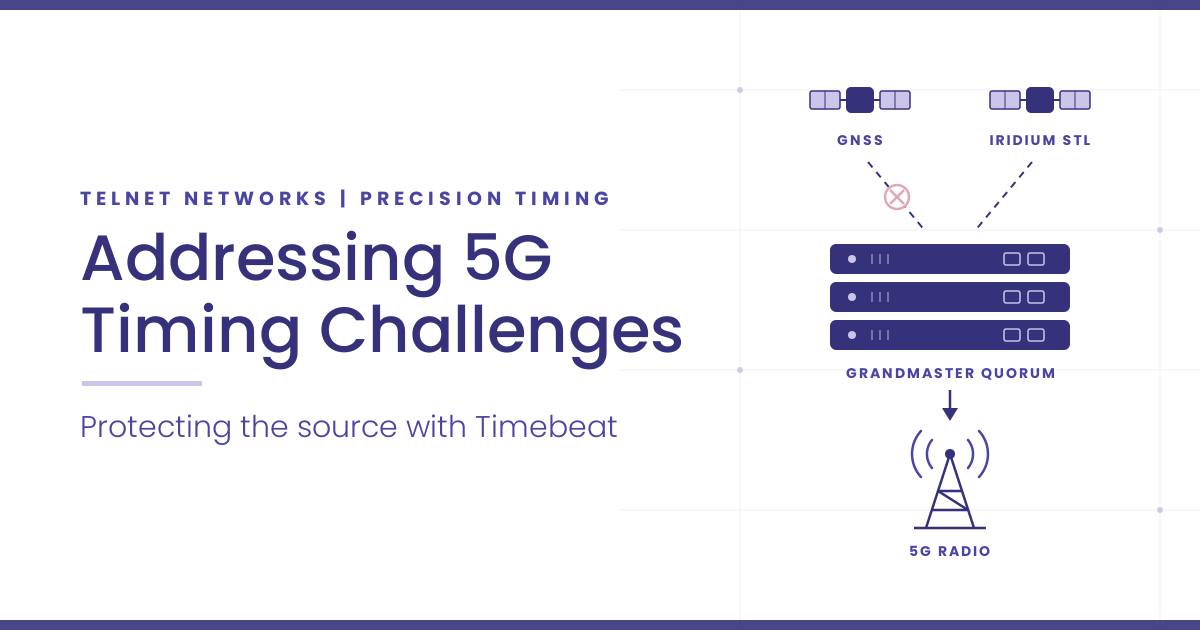
- Redundant, diverse time references: Relying on a single GNSS source creates a single point of failure. Hardware-based grandmaster clocks with multiple reference inputs (GNSS, OCXO holdover, PTP upstream) provide resilience against spoofing, jamming, and outage. Interference Detection and Mitigation (IDM) capabilities add another layer of protection for GNSS-dependent timing infrastructure.
- Network-internal distribution: Minimizing dependence on external NTP servers by deploying boundary clocks and internal PTP grandmasters reduces exposure to external attack surfaces.
- Time monitoring and alerting: Just as you monitor network traffic for anomalies, monitoring clock health across critical nodes, detecting drift, jitter, or unexplained offsets should be part of SOC operations.
- Traceability to authoritative UTC sources: For regulated environments, demonstrating that timestamps are traceable to UTC through an auditable chain of custody is increasingly a compliance requirement.
Safran’s timing portfolio, including their SecureSync platform and White Rabbit solutions, represents the high-assurance end of this spectrum, delivering GNSS-disciplined, highly redundant grandmaster clocks capable of maintaining sub-microsecond accuracy even during GNSS outage through precision oscillator holdover. Their White Rabbit implementations bring this level of accuracy directly into critical network infrastructure.
Timebeat takes a complementary approach, delivering software-defined PTP synchronization that enables accurate, resilient time distribution across hybrid and cloud-connected environments. Timebeat’s mesh-based PTP architecture removes traditional single points of failure in timing distribution trees, making high-accuracy time achievable in dynamic, distributed environments where hardware-only solutions face constraints.
Together, solutions like these address the full range of enterprise time infrastructure needs — from the hardened core of a critical facility to the distributed edges of a hybrid cloud environment.
Time Security Is Network Security
Time synchronization rarely gets a line item in a security budget, but in a Zero Trust environment, it should. An unauthenticated, unmonitored NTP deployment is an unaudited trust surface, and that’s an inconsistency that Zero Trust was designed to eliminate.
The right answer isn’t always a full PTP overhaul. For many organizations, the first step is simply authenticating existing NTP with NTS, monitoring for clock drift as part of SOC operations, and ensuring time sources are resilient and traceable. From there, the path to hardware-assisted PTP or White Rabbit is well-understood and incremental.
At Telnet Networks, we work with organizations across Canada to assess time infrastructure gaps and align timing solutions with broader network security and Zero Trust strategies. Get in touch to start the conversation.
Ready to assess your time infrastructure’s role in your Zero Trust strategy? Contact the Telnet Networks team to start the conversation.