
UNDERSTANDING ZERO TRUST — WHY VISIBILITY IS THE BEDROCK OF “NEVER TRUST, ALWAYS VERIFY”

In our first post, we demystified the core philosophy of Zero Trust—shifting from the outdated “castle-and-moat” perimeter to a model that assumes a breach has already occurred. But once you’ve embraced the mindset of Never Trust, Always Verify, a practical question emerges: How do you verify what you cannot see?

At Telnet Networks, we break Zero Trust down into three actionable pillars: Enable, Protect, and Recover. Today, we’re diving into the first and most critical foundation: Pillar #1 – Enable.

The “Enable” Pillar: Fueling the Trust Engine

The “Enable” phase isn’t about blocking traffic or setting up firewalls—that comes later. This pillar is focused entirely on data availability.

Zero Trust is a data-hungry architecture. To make real-time, “verify explicitly” decisions, your security tools need a constant stream of high-fidelity telemetry from every corner of your network. If your security stack is blind to certain traffic segments, your Zero Trust strategy isn’t just incomplete, it’s dangerous.

The Telnet Perspective: You can’t secure what you don’t monitor. Enabling Zero Trust means ensuring that every packet is captured, aggregated, and delivered to the tools that need it.

Why Visibility is the Foundation

Reputable frameworks like NIST SP 800-207 and the CISA Zero Trust Maturity Model emphasize that visibility and analytics are the cross-cutting capabilities that support every other pillar of security. Without the “Enable” phase, your organization faces several “Zero Trust Killers”:

  • Encryption Blind Spots: While encryption is vital for privacy, it can hide malicious activity.
  • Siloed Data: If your SIEM or NDR only sees a fraction of your traffic, its AI-driven “anomalies” are just guesses.
  • Shadow IT: Unauthorized devices and applications can’t be “verified” if they are invisible to the network management layer.

The Toolkit: Network TAPs and Packet Brokers

In a Zero Trust architecture, “visibility” is not a passive luxury—it is the active fuel for your policy engine. To move toward an optimal maturity level, as defined by the CISA Zero Trust Maturity Model, an organization must collect as much information as possible about the current state of assets and communications. This requires two essential components: Network TAPs and Network Packet Brokers (NPBs).

While some organizations attempt to use SPAN (Switch Port Analyzer) ports for visibility, this often creates “Zero Trust Blind Spots.” SPAN ports are prone to packet loss under heavy load and frequently filter out the very error packets and anomalies that indicate a breach. To truly enable Zero Trust, you need a hardware-based foundation that guarantees 100% data fidelity.

Network TAPs: The Foundation of Ground Truth
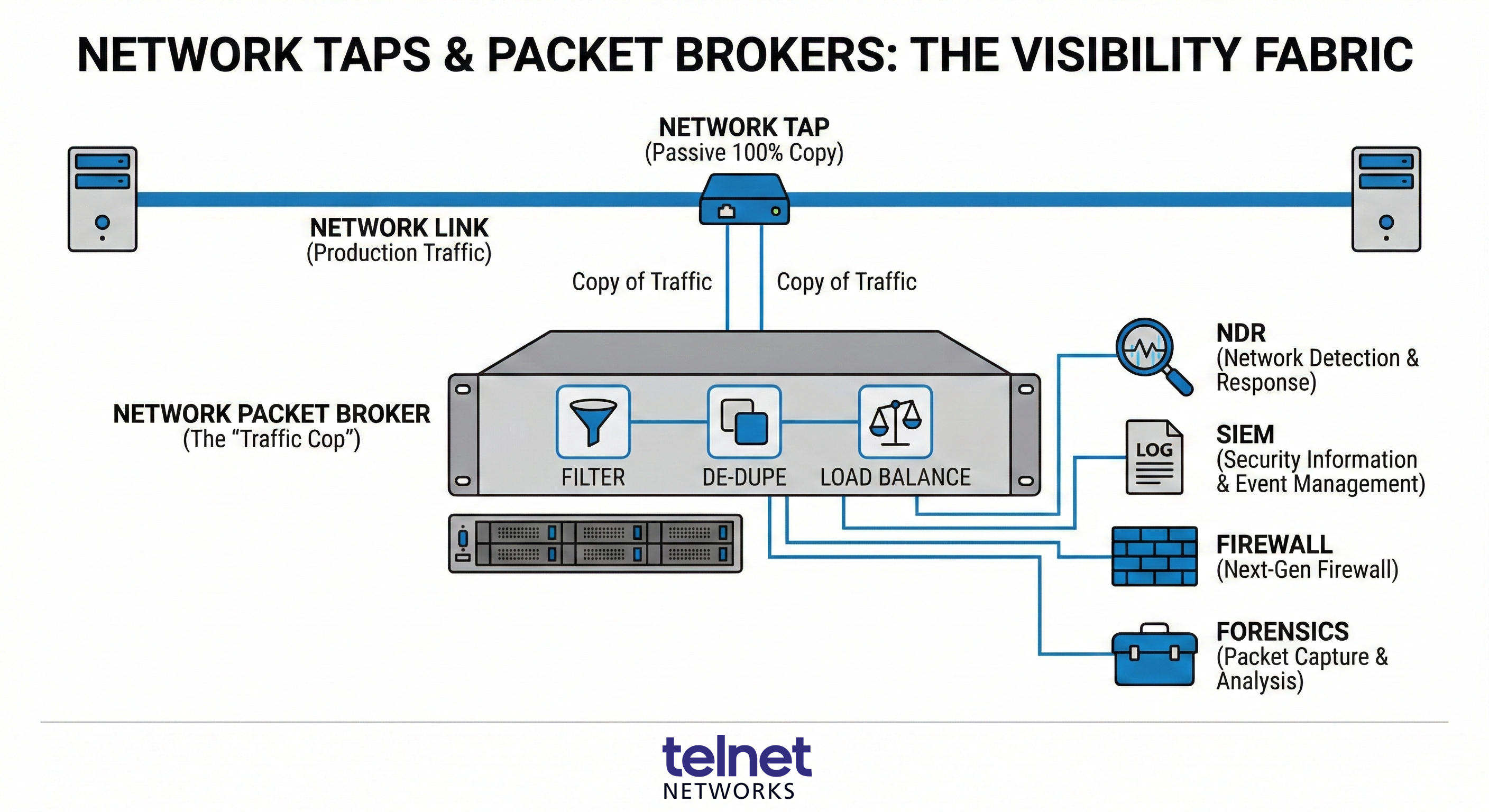
A Network TAP (Test Access Point) is a purpose-built hardware device that provides an exact, unaltered copy of all traffic flowing between two points in a network.

  • 100% Capture: TAPs capture every bit, byte, and packet, including physical layer errors that traditional software-based monitoring might miss.
  • No Performance Impact: Because they are passive or use “fail-safe” bypass technology, TAPs do not introduce latency or become a point of failure for the production network.
  • Security by Design: Unlike managed switches, TAPs are “invisible” to the network and cannot be remotely hacked or misconfigured to stop traffic.

Network Packet Brokers: The Traffic Cop for Your Security Stack

Once the TAPs have captured the data, it must be delivered to your security tools (like NDR, SIEM, or DLP). However, sending 100% of raw traffic to every tool would quickly overwhelm them, leading to dropped packets and wasted licensing costs. Network Packet Brokers act as the “intelligence layer” between your network and your tools:

  • Aggregation and Filtering: NPBs can take traffic from multiple TAPs and filter out irrelevant data (e.g., streaming video traffic) so your security tools only process what matters.
  • De-duplication: If traffic is captured at multiple points, NPBs remove duplicate packets to ensure tools aren’t working twice as hard for the same insight.
  • Load Balancing: High-speed 100G or 400G traffic can be distributed across multiple lower-speed security appliances, extending the life and ROI of your existing hardware.

Choosing the Right Partner for Your Industry

At Telnet Networks, we partner with the world’s leading visibility vendors to ensure we can match your industry or organization specific requirements. While all of our partners offer comprehensive portfolios of both TAPs and Packet Brokers, they each bring unique strengths to the table:

  • Garland Technology: A leader in securing Critical Infrastructure and Government networks. With US-based manufacturing, Garland is often the preferred choice for Canadian organizations with strict compliance mandates in energy, finance, and healthcare where “Made in North America” and extreme reliability are paramount.
  • Profitap: Focused on high-end Forensics and Deep Packet Capture. Based in Europe, Profitap serves over 1,000 clients globally, including many Fortune 500 companies. Their solutions are ideal for organizations that require specialized, portable, or high-density troubleshooting tools for R&D and complex incident response.
  • Cubro Network Visibility: Known for providing a high ROI in Telecommunications and Data Centers. Cubro is a favorite for service providers and large enterprises looking for high-performance 4G/5G visibility without the burden of annual port or software licensing fees, significantly lowering the Total Cost of Ownership (TCO).
  • Keysight Technologies: Offers perhaps the Broadest and Most Advanced Visibility Portfolio. Serving the aerospace, defense, and automotive sectors, Keysight’s “Vision” series is designed for the most complex hybrid-cloud environments, featuring advanced AI/ML stacks and context-aware application filtering.

By correctly implementing the Enable pillar with these tools, your organization creates a “visibility fabric” that removes the shadows where attackers hide. Only then are you ready for Pillar #2: Protect.

Moving Toward Maturity

Implementing the Enable pillar is the first step in a phased approach. It allows Canadian enterprises to move beyond “just keeping the bad guys out” to a proactive stance where they can find them quickly and limit damage when they do get in.

What’s Next? Establishing visibility is just the beginning. In our next article, we will explore Pillar #2: Protect, focusing on how to use that visibility to enforce least-privilege access and micro-segmentation. Stay tuned as we continue to build out the blueprint for a resilient, Zero Trust-enabled enterprise.

Telnet Networks’ Approach to Zero Trust: A Practical Guide for Modern Enterprises

Zero Trust has quickly evolved from a niche cybersecurity concept into a foundational strategy for organizations looking to secure increasingly distributed, hybrid, and cloud-connected environments. But despite the widespread adoption of Zero Trust terminology, the path to implementation remains complex—and many organizations still struggle to translate theory into operational practice.

At Telnet Networks, we help organizations across Canada build real-world Zero Trust architectures backed by visibility, endpoint assurance, segmentation, identity controls, and continuous monitoring. Our approach is rooted in the principle that Zero Trust is not a product—it’s a strategy supported by coordinated technology, operational alignment, and ongoing improvement.

We provide a clear, jargon-free explanation of Zero Trust and introduce Telnet Networks’ three-pillar model for Zero Trust enablement: Enable, Protect, and Recover.


What Zero Trust Really Means

“Never trust, always verify” is the classic tagline—but it only scratches the surface.
Zero Trust is a security model built on three core principles:

1. Assume Breach

Organizations must plan as though a compromise has already happened.
Security strategies shift from keeping attackers out to limiting their movement, detecting them quickly, and minimizing damage.

2. Verify Explicitly

Every user, device, application, and data request must be authenticated and continuously validated.
This includes:

  • MFA and adaptive authentication
  • Device posture checks
  • Behavioral analytics
  • Location and context-based risk scoring

With stolen credentials involving 86% of breaches, verification cannot stop at the login screen.

3. Least Privilege Access

Provide users only the access they need, for the time they need it, under the conditions appropriate for their role.
This reduces lateral movement and limits insider risk.

Why Zero Trust Is Necessary

Today’s networks no longer have a meaningful perimeter. Cloud adoption, remote work, IoT/OT integration, and SaaS have made traditional “trusted internal, untrusted external” models obsolete.

Attackers have evolved too. AI-powered malware, credential theft, and automated intrusion tools make it easier than ever for threats to bypass traditional defenses.

Organizations need a new default mindset: trust nothing unless continuously verified.

Key Technology Areas That Support Zero Trust

Zero Trust is multi-disciplinary by design. Telnet Networks helps organizations evaluate, integrate, and operationalize the following core building blocks:

Identity & Access Management (IAM)

  • MFA, SSO, RBAC
  • Continuous authentication
  • Context-based and adaptive access controls

Network Segmentation & Micro-Segmentation

  • Reduces lateral movement
  • Isolates sensitive assets
  • Enforces east-west traffic controls

Endpoint Security (EDR/XDR)

  • Device posture checks before granting access
  • AI-enabled threat detection
  • Continuous monitoring for malware and vulnerabilities

Network Visibility & Monitoring

Zero Trust requires deep insight into how traffic moves across the network.
Telnet’s ecosystem includes:

These provide the forensic depth necessary to validate trust, detect anomalies, and respond to threats.

Data Security

  • Encryption at rest, in transit, and in use
  • Secure key management
  • Data access monitoring and anomaly detection
  • Backup, resilience, and recovery tooling

The Telnet Networks Zero Trust Model: Enable, Protect, Recover

While Zero Trust frameworks often focus on design principles, Telnet’s approach emphasizes implementability.
Our three-pillar model ensures the underlying data, detection technology, and response capabilities are aligned.

1. ENABLE — Ensure Data Availability for Trust Decisions

Zero Trust relies heavily on timely, accurate telemetry.
Telnet provides the tools that make trustworthy security analytics possible:

  • Network TAPs and Packet Brokers for complete packet data
  • Traffic aggregation for SIEM, IDS/IPS, NDR, and analytics platforms
  • Real-time and historical visibility for investigations

If data is missing or incomplete, Zero Trust cannot function.

2. PROTECT — Identify, Isolate, and Remove Threats

Protection requires active, integrated security controls:

These tools prevent lateral movement and stop credential-based attacks before they escalate.

3. RECOVER — Prepare for When Breach Happens

No Zero Trust implementation is complete without strong recovery and forensic capabilities.

Telnet supports organizations with:

Recovery closes the loop, ensuring organizations understand what occurred—and how to strengthen defenses going forward.

Challenges Organizations Face on the Zero Trust Journey

Zero Trust is powerful, but it isn’t easy. Common challenges include:

Encryption Blind Spots

Encrypted traffic protects privacy but reduces visibility. DPI, decryption zones, and metadata analysis are essential counterbalances.

User Experience Trade-offs

Too many authentication prompts frustrate users; too few create risk.
Adaptive and context-aware IAM is the solution.

AI-Powered Threats

Attackers now use AI to evade detection, generate phishing campaigns, and automate intrusion attempts.
Organizations must counter with AI-driven analytics and anomaly detection.

Lack of a Cohesive Strategy

Zero Trust fails when implemented in silos.
Network, security, cloud, and application teams must collaborate around a unified plan and departments must be aligned on policies, tools, enforcement and training.

Zero Trust Requires a Phased, Holistic Roadmap

Based on Telnet’s experience, successful Zero Trust initiatives share these characteristics:

  • A multi-year, phased rollout strategy
  • Cross-departmental alignment
  • Harmonized access and security policies
  • Continuous iteration—not a one-and-done project

Zero Trust is a journey, not an appliance.

How Telnet Networks Helps Organizations Move Forward

As a Canadian leader in network visibility, endpoint protection, and cybersecurity enablement, Telnet Networks brings:

  • Over 20 years of enterprise and government experience
  • A best-of-breed technology ecosystem
  • Strong partnerships with innovative OEMs
  • A vendor-agnostic, customer-first consulting approach

Whether building from scratch or strengthening an existing roadmap, Telnet provides the tools, expertise, and guidance needed to translate Zero Trust from theory into operational practice.

Start Your Zero Trust Journey With Telnet

If your organization is evaluating Zero Trust—or needs help advancing an existing initiative—Telnet Networks is ready to help.