Running a 911 dispatch centre means keeping CAD, radio, call-handling, and recording systems working for the people who depend on them every shift. With all of that competing for attention, the clock on the wall is easy to treat as background noise.
In reality, time is the invisible backbone of every Public Safety Answering Point (PSAP). When seconds count, a discrepancy of even a fraction of a second can disrupt critical emergency coordination or compromise vital evidence in a courtroom.
That’s why the National Emergency Number Association (NENA) publishes a dedicated PSAP Master Clock Standard (NENA-STA-026.5). The timing is pressing for Canadian centres, too: the CRTC has set March 31, 2027 as the deadline to decommission legacy 9-1-1 networks, and the move to IP-based Next Generation 9-1-1 (NG9-1-1) puts more of your systems on the network, all depending on a shared time source. Here is what the standard asks for, why it matters, and how modern equipment makes getting in sync easier than ever.
Why Precision Time Matters in the PSAP
In a PSAP, even a slight drift between dispatch consoles, CAD logs, and recorder feeds can derail an incident timeline and weaken critical evidence. A modern, NENA-compliant master clock turns that overlooked vulnerability into a dependable asset in four ways:
1. Accuracy Measured in Tenths of a Second
In an emergency, fractions of a second matter. Under the NENA standard, the PSAP master clock must be traceable to Coordinated Universal Time (UTC) and stay within 0.1 seconds of it while locked to its time source. Equipment that takes time from the master clock, such as CAD, voice recorders, and radio consoles, must stay within ±0.25 seconds of the master. A compliant master clock pulls precise time from satellites (GNSS, most commonly GPS) and distributes it across your network, so call logging, radio dispatch, and event records share one consistent timeline.
2. Bulletproof Legal Evidence
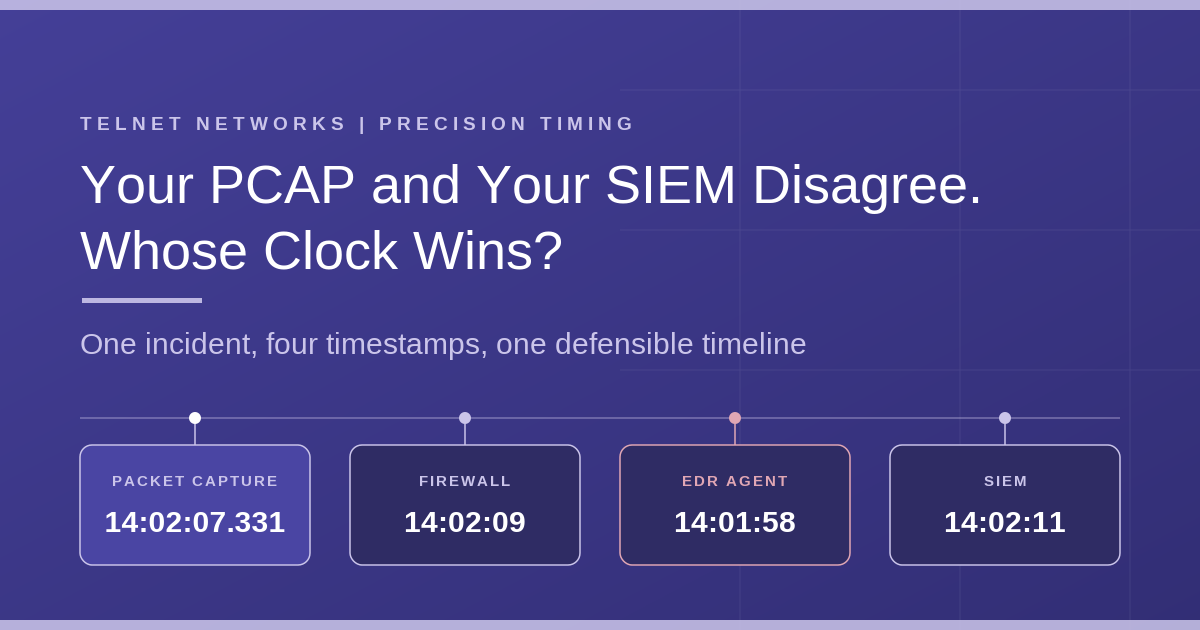
When a 911 call ends up in a courtroom, the timeline is everything. Picture a voice recorder running two seconds behind CAD: on paper, the call-taker appears to dispatch units before the caller gave the address. Mismatches like that give opposing counsel an opening to question the entire sequence of events. Because a NENA-compliant master clock is traceable to UTC, every timestamped record in your centre points back to one authoritative reference, which removes one of the most common ways to challenge a timeline during an investigation or at trial.
3. Stronger Security & Signal Reliability
Accurate time underpins network security, too: authentication, certificate checks, and security logs all depend on it. Satellite timing signals are weak by the time they reach your antenna, and inexpensive equipment can jam them or spoof them with false time. Better master clocks can detect jamming and spoofing, raise an alarm, and keep time on a precision internal oscillator (known as holdover) until the signal can be trusted again. Pair that with authenticated NTP and good network hardening, and your time source stops being an easy target.
4. Surprisingly Easy Installation
You might think upgrading your clocks means tearing up walls and hiring electricians to pull new power lines. Not anymore. Today’s synchronized clocks use Power over Ethernet (PoE). They get both their data and their power from a single, standard network cable. It’s cost-effective, incredibly safe, and practically plug-and-play.
Top Suppliers for NENA-Compliant Time Synchronization
A NENA-compliant time system has two layers, and it helps to think about them separately.
The master clock, or time server, sits in the equipment room. It takes time from a GNSS antenna on the roof, keeps it on a precision internal oscillator, and distributes it across the network using Network Protocol (NTP) or Precision Time Protocol (PTP). This is the device the NENA standard is really about: it must stay traceable to UTC, keep accurate time if the satellite signal drops, and trigger an alarm when it loses power or synchronization. For centres that can’t tolerate a single point of failure, a second master clock or a backup time source provides failover.
Everything else takes its time from the master: CAD, call-handling equipment, voice recorders, radio consoles, and the wall clocks on the dispatch floor. Wall clocks don’t make a centre compliant on their own, but they are the part of the system dispatchers actually see, so they should take time over the wired network and show clearly when they have lost sync.
Telnet Networks partners with timing manufacturers that cover both layers. Safran and Bodet supply master clocks and time servers; Sapling, Novanex, and Bodet supply the displays your dispatchers see. Here is what each brings to the table:
Safran provides the core hardware engine for mission-critical networks, anchored by its flagship SecureSync® series.
- Network-Wide Sync: Distributes precise GNSS time to CAD systems, 911 voice recorders, and radio consoles via NTP and PTP.
- Signal Holdover: Internal precision oscillators (TCXO, OCXO, or Rubidium) maintain exact time even during satellite signal outages.
- Cyber Defense: Integrated BroadShield technology actively detects and avoids GPS jamming and spoofing attempts.
Sapling focuses on putting synchronized time directly in front of dispatchers through an adaptable lineup of wall clocks and controllers.
- Flexible Options: Available in IP-PoE, Wi-Fi, and synchronized RF wireless configurations, in both digital and analog formats.
- “TalkBack” Technology: Wireless clocks communicate two ways with the master controller, boosting signal reach by acting as repeaters while reporting battery health and operational status to IT.
- Browser-Based Control: Built-in web interfaces allow individual monitoring and configuration for every IP-enabled clock.
Novanex specializes in heavy-duty digital wall displays designed for fast deployment and minimal upkeep.
- True Single-Cable Setup: Standard 4-digit and 6-digit models pull power and NTP time directly through a single Cat5/Cat6 network cable.
- Durable Construction: Built with industrial aluminum or stainless steel enclosures and high-visibility red or green LEDs.
- Visual Fail-Safe: If a clock loses communication with the time server, it automatically displays dashes so dispatchers never rely on drifted time.
Bodet delivers a complete, unified ecosystem connecting server-rack hardware directly to dispatch floor displays.
- Modular Time Servers: The Netsilon series (7, 9, and 11) delivers high-stability internal oscillators and advanced security against spoofing.
- Display Variety: A broad selection of PoE and Wi-Fi digital LED, LCD, and analog clocks fits any room layout.
- Centralized Management: A clean, web-based dashboard lets administrators configure time-code outputs and monitor whole-facility system health from a single screen.
Ready to get your dispatch center on the same page? Upgrading to a NENA-compliant time system doesn’t have to be a complicated, stressful project. If you’re ready to improve your coordination, compliance, and security, contact our sales team today.